quick note to bring you up to speed what happened for the past 30 days
The Federal Reserve’s Further Rate Cut Decision
Imagine trying to drive through thick fog—you can’t see what’s ahead, and every move feels risky. That’s exactly what the Federal Reserve is doing right now. Their decisions about interest rates are creating waves in the US markets with ripples felt by the rest of the markets globally.
Not long ago, the expectation is – Federal Reserve would continue to cut interest rates in December. Now, that confidence has somewhat taken a step back.
The Fed’s voting members are split, and no one knows what they’ll decide. Here’s the catch: the Federal Reserve has 12 voting members, but their recent meeting minutes revealed that opinions are all over the place.
Some want big rate cuts, others want small ones, and many don’t want any cuts at all.
This kind of public disagreement is rare for the Fed, which usually tries to show a united front.
—
Why It’s Happening: A Tug-of-War Between Inflation and Jobs
The Federal Reserve has two big jobs: keep inflation low and make sure people have jobs.
Currently, both are going in the wrong direction.
Inflation isn’t dropping as fast as they hoped, and the labor market is getting a bit shaky.
The unemployment rate rose from 4.3% to 4.4% in September. Plus, job cuts are skyrocketing. In October alone, U.S. companies announced over 153,000 layoffs—a 175% jump compared to last year.
And it’s not just layoffs; more companies are planning even bigger cuts.
I am seeing the ripple effect play out in real time – just this week, a Malaysian couple working in Singapore for the past 15 years engaged me for advisory to explore retirement in Malaysia if they were to sell their 1800sqf home for $6 million, which has appreciated from $4 million since 2017. The trigger event? Husband’s expecting to be offered VSS as soon as Jan next year.
The Ripple Effect: Markets Don’t Like Uncertainty
This uncertainty is hitting stocks, bonds, and even crypt0 hard. One month ago, the odds of a December rate cut were nearly guaranteed. Now, they’ve dropped to just 39.5% according to CME Fed Watch Tool.
Why the shift? The Fed is struggling to make decisions without clear data. The recent US government shutdown caused a 44-day blackout in economic reports. Key numbers like inflation, GDP, and job stats were delayed, leaving the Fed to guess what’s really happening.
A Glimmer of Hope: QT Is Ending
Here’s one piece of good news: the Federal Reserve unanimously decided to stop shrinking its balance sheet, a process called quantitative tightening (QT). Ending QT means more liquidity in the financial system, which is good for all investment assets. But the real game-changer will be their decision on interest rates.
And this week, though, markets rebounded.
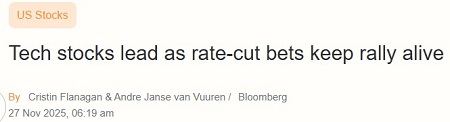
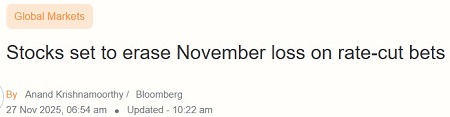
Even if the Fed doesn’t cut rates in December, there’s still hope for January. Right now, there’s a 70.1% chance they’ll cut rates at one of these two meetings. And there’s a smaller chance—19.9%—that they’ll cut rates at both.
TL;DR FAQ
Q: Why is the Federal Reserve divided on rate cuts?
A: Because inflation remains high, but the labor market is weakening, pulling policy in opposite directions with no clear consensus.
Q: What caused the recent confusion about the Fed’s intentions?
A: Vague language in the October minutes, delayed economic data due to US government shutdown, and conflicting Fed member opinions.
Q: How does ending Quantitative Tightening (QT) affect markets?
A: Ending QT stops the draining of liquidity from financial markets, providing a supportive environment for stocks, crypto, and precious metals.
Thank you for the support, and I wish you a very nice day. Take care.
Lieu
p.s. –
Keywords and Definitions
Federal Reserve (Fed): The US central bank responsible for monetary policy, including setting interest rates.
Interest Rate Cut: A reduction in the benchmark interest rate to stimulate economic growth.
Quantitative Tightening (QT): The process of shrinking the Fed’s balance sheet by selling assets or not reinvesting proceeds.
Dual Mandate: The Fed’s goal to promote maximum employment and stable prices (low inflation).
CME Fed Watch Tool: A market tool that calculates probabilities of Fed rate moves based on futures prices.
Government Shutdown: A period when US government operations are halted due to funding disagreements, delaying data releases.
Highlights
Pavilion REIT posts 20% profit growth in 3Q25 | The Star
Atrium-REIT expects steady showing in 4Q | The Star
KIP REIT to see better earnings in 2QFY2026 on new assets — analysts
Sentral REIT posts lower 3Q earnings as repair costs weigh on income
Sunway REIT’s 3Q NPI rises 25% to RM181 mil on new asset contributions
Positive outlook for Axis-REIT on land buy proposal | The Star
Sentral-REIT occupancy rate expected to rise | The Star
Axis-REIT’s largest-ever acquisition signals growth | The Star
IGB REIT boosts total assets to RM8.09b with completed acquisition of The Mall, Mid Valley Southkey
Hektar REIT sees growth with asset enhancement, strategic acquisitions | The Star
Atrium-REIT expects steady showing in 4Q
Sunway-REIT’s Seberang Jaya hotel sale a positive
Sunway Reit unveils RM602mil property developments
Axis REIT acquires RM800m Penang industrial asset, secures leaseback from Ann Joo Steel
IOI Properties eyes REIT listings in Malaysia, Singapore, with assets of US$8 billion, sources say
UOA REIT profit dips slightly in 3Q on higher maintenance costs
Al-Salam REIT launches RM455m senior sukuk wakalah issuance
Al-Salām REIT Quarterly Net Income Surges 136% To RM3.3 Million
Al-`Aqar Healthcare Reit delivers stable Q3 results with steady rental growth
Leave a Reply