Category: MASTERY

  • REIT Dividend Breakdown – Taxable, Non-Taxable & Tax-Exempt?

    When you really get your hands dirty REIT investing, you will receive your dividend vouchers in your (snail) mail box regularly.

    Sometimes, you may notice, the REIT dividends declared are further break-down into these 3 categories:

    • Taxable
    • Non-taxable
    • Tax-exempt

    What do they mean?

    Credits to Lok, Chee Cong for the screenshot

  • What if…other Stocks Gives Higher Dividend Yield?

    From time to time, you may come across news or article which highlight non-REIT stocks in the share market that gives exceptionally high yield, circa 9 to 12%!

    When you do encounter such stocks, should you dump REIT stocks and shift your portfolio to these high-dividend yield stocks?

    3 Extensive Lessons for you to digest – DO NOT miss any below:

    Part 1

    Part 2

    Part 3

  • Need Double Digit Annual Return from Investment? Learn this (a MUST)

    REIT dividend yield and less volatile stock price bore you?

    Itching for some ‘excitement’ to get 20% return in a year?

    Then understand this first before you jump in.

  • MBTI to Supercharge your Investing Result

    Don’t work on your weakness, focus on harnessing your strengths in every areas of your life, including investing.

    Digest the lesson to gain an edge in your investing journey.

    It could help you immensely too in your career and relationships.

  • Worst Case Scenario in REIT Investing

    This is a case study for an incident that happened to Sabana REIT, an industrial REIT based in Singapore.

    It is hard to find another examples where DPU dropped almost 50% in 3 years, while the REIT manager fees remained largely unchanged.

    If you mastered everything in REITMethod, you can likely prevent such scenario from happening to you.

    Last but not least, remember that in the investing world, even though you have done everything, what other people do may still hurt you (cause you to lose money). The best analogy I can give you is this video below:

  • Evaluating Acquisition – Yield Accretive?

    If the Manager acquire a property, how do we know it is beneficial to investors, based on public information available? I’ll show you how here.

    Another example would be KIP REIT asset acquisition in 2019

  • Understanding & Dealing with REIT Capital Raising

    REITs, unlike normal stocks listed on the market are able to pay out their dividend cash flow distributions from their free cash flow.

    In fact, REITs are able to pay out higher than net income as they do not have to pay corporate taxes.

    And because of this (pay out  almost all their cash flow as dividends), they retained very little cash flow to carry out initiatives to grow, such as the purchase of new property assets.

    The only options is for REITs need to tap the capital markets.

    And that means equity or debt financing, but commonly, a hybrid of both.

    For equity financing, there are 2 options – private placement or public placement.

    The private placement route is much quicker way of raising capital and the discounts given tend to be small (3-5%) as compared to rights issues where the discounts can be as high as 20% and is highly dilutive.

    Practically,  rights issue can take up to 6-12 months and the pricing is subject to market forces in that period. A private placement can be completed in 2-3 months with tight pricing.

    The lesson below explains more.

    Here’s an example

    To further understand more on Private Placement vs Public Placement for Capital Raising using Equity, watch the lesson below:

  • When to Sell a REIT, and the 3 most important criteria in REIT portfolio review

    The thought of selling a REIT might run through your head.

    • Should you sell the REIT to realize the capital gain profit?
    • Wait for the REIT to recover if there is capital loss more than 1 year, while earning the dividends?

    Today, we are going to explore my framework how I decide whether to sell my REITs.

    And the 3 most important criteria to consider during the review your REIT

    1) Competency and Integrity of the Managers of the REIT

    2) Jobs, Business and Economy

    3) Valuation of the REIT

    And finally, here are the only 2 Good Reasons you want to sell your REIT holdings (and it’s not because

    1. Discovered a Better Opportunity, which often means – better prospects, lower risks and better bargain (in terms of DPU yield, which relates to share price) compared to your current ones.  Truly, due to time restraint, it is nearly IMPOSSIBLE to spot emerging (and often hidden) opportunity just by yourself, which is why we offer Subscription membership which provides with easy access to all updates in once place.
    2. Reason for Buying No Longer Valid – as time goes by, every business will evolve and face different set of challenges.  There are times when initial reason to buy a REIT is because it has high growth potential due to new property acquisitions. However, it turns out that the new assets injection does not deliver profits as you hope for. If that’s the case, it is probably the time to let it go, even at a loss, and move on.
    3. You need the sales proceeds for emergencies (Life & Death situation – self-explanatory

    See a snapshot of such SWITCH-SELL-THEN-BUY transaction :

    Then consume the lesson below for clarity

  • Detecting if there is any abnormal ‘operations’ by the REIT Manager

    The primary thing to take note to detect ‘abnormal’ operations by the REIT manager is to check if there is any artificial income boosting involved.

    As you already know, rental income is the life line of any REIT. So it is abnormal when rental income is fakely pumped so that investors get high DPU temporarily. This ‘fake’ rental pump is normally not supported by real rental rate or market demand.

    Fake rental pump can be either comes from capital (usually from divestment aka sale proceeds of a property) or GRR aka Guaranteed Rental Rate by the property seller (where REIT is the buyer).

    However, there is no absolute good or bad in this – study the lecture below and you’ll understand better that in some instances, it is a common practice and isn’t really a red flag.

    Real examples in 2020

  • How Interest Rate Change would Impact REIT profitability

    REIT is one of the asset class which really feels the impact of changing interest.

    It could be good, and it could be bad. Like a two-edges sword.

    Here is how to determine what interest rate environment is beneficial to a REIT’s profitability, and what isn’t.


  • How eCommerce is Reshaping Industrial REITs

    eCommerce not only affects retail REITs…

    …it also changes how industrial REITs evolve going forward.

    The sky’s the limit.

    Understanding this will make you leaps and bounds ahead of most retail investors out there.

  • Construct a REIT Portfolio Tracking Sheet

    1. How to construct your own REIT stocks tracking sheet – a high level snapshot
    2. How such tracking sheet helps you decide if you should buy more if the price drops
    3. How to leverage information from REITMethod subscription content to help you fill up the details for the tracking sheet

    If you need to download the tracking sheet template itself, please upgrade your membership level HERE

  • Construct a Detailed REIT Portfolio Reinvestment Plan

    A REIT portfolio is probably the best tool in the world to generate cash-flow focused investment return passively to replace your expenses need, besides fixed/cash deposit.

    But what if you don’t need to use the cash flow from REIT dividends immediately to cover for your expenses need?

    What if you were to reinvest all the annual dividends received, into your original REIT portfolio, the following year?

    How do we draft, visualize, project and track the entire portfolio progression?

    This lesson will shed light on that.

  • Why you can’t get the dividend yield you want

    After you’ve been investing in REITs long enough, you will start to feel this way:

    “How come the price of the REIT I intend to buy never drop to a level where I can get at least 6% yield?”

    “Am I doing anything wrong?”

    This module will reveal and clarify everything for you, so make sure you commit your time to really understand it

  • Global REIT Investing: Bench marking the Best

    2 words of utmost importance here: Benchmark and ‘the Best’.

    Where to benchmark? Answer: US – the bellwether of global economy

    Who to benchmark? Answer: Warren Buffett & Berkshire Hathaway – legendary

    Follow the 3 lessons below in sequence to grasp the idea why REIT, as an asset class, is so powerful throughout multiple cycles of economic ups and downs

    Lesson 1: Even world’s best investor had deteriorating performance over time due to high ‘competition’ & information ‘liberalization’


    Lesson 2: The second best asset class to closely match the world’s best investor investment return for the past 20+ years

    Note: concepts covered in these lessons still apply, but refer to the updated tables below


    Lesson 3: To complete Lesson 2, we analyzed how had other asset classes performed in the same duration

    NOTE: Up-to-date data for the above is available when you schedule a 1on1 consultation call with me ~ I’ll show you everything up to most recent full financial year

  • AmFirst REIT Rights Issue Case Study in 2012

    I’ll share with the rest of the REIT Method community on how you can do the due diligence yourself, not only for this AmFirst REIT, but for other REIT rights issue as well.  Bear in mind that AmFIRST rights issue is the first for any M-REIT, so it is worth studying this although it is a bit outdated

    In case you are not aware,  AM Ara (property manager) has proposed renounceable rights issue of 3 new units for every 5 existing units held under an investor’s portfolio.

    In layman terms, for every 500 shares (5 lots) of AmFirst REIT you currently have, you are entitled to buy additional 300 (3 lots) shares, at a subscription price of RM 0.85/share in mid July.

    Is this a good thing? To answer this, lets take a look at 2 things below.

    The purpose of this rights issue

    The REIT manager stated that it wants to grow its portfolio by investing in more properties in high-growth areas such as Penang, Melaka and Johor. Apparently, they are now moving their focus from KL/Klang Valley to other places where asking prices and rental yields are more reasonable. Scope and size of the the properties is still under wraps, as they claimed they are still doing some “due dilligence” exercise.

    Read: AA – Asset Acquisition Effort, one of the criteria of active asset management we want to see in a REIT, as stated in Module 3.

    Its current Gearing Ratio

    To quote Transformers the movie, there is always more than meets the eyes.

    Let’s do a quick check into its latest quarterly financial statements, and look at the gearing ratio.
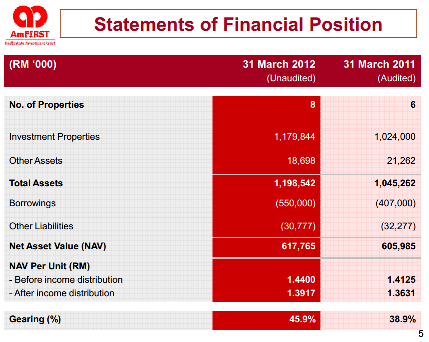
    It is at 45.9 percent, up from 38.9% from the same quarter last year.

    Reason of the increase in gearing: New Property Acquisition of Prima 9 and Prima 10 at Cyberjaya, both are relatively new office buildings. It is normal to see gearing shoot up after acquiring new assets.

    Bonus point#1 to note: Both commercial office buildings are 100% tenanted as of the time of this writing.

    Bonus point#2 to note: One of the major tenants is Hewlett-Packard, a MNC (multinational company). Established MNC are normally quality tenants known for long lease.

    Even though the manager said the right issue is for asset growth, its equally, if not more, important aim is to pare down the gearing ratio to below 30 percent.

    Why is this so?

    There is no way AmFirst can acquire new properties this year with only less than 5 percent margin before hitting the 50% gearing ratio upper limit. Besides that, reducing the gearing will indirectly result in interest (over its borrowings) savings as well.

    This is prudent capital management in strengthening the REIT’s balance sheet via capital raising. The property manager is doing the right thing.

    Conclusion: With all the info we know so far, subscribing to this rights issue is recommended.

    This article does NOT form part of the contract in whatsoever way if any. We are solely sharing our own personal opinions on this particular investment opportunity base on our best knowledge on this matter which may be limited in certain aspects that we are not aware of at the time of this article was posted.
    We make no warranty or representation about the content of on this tutorial although we try to provide the most accurate info available to us. It is your responsibility to independently confirm its accuracy & completeness. Any projections, opinions, assumptions or estimates used are for example only & do not represent the current or future performance of the REIT. If you have questions or concerns regarding this issue conduct further inspections by a qualified professional.
    The information provided on or within this website or in documents available herein is for assistance only and is not intended to be and must not be taken alone as the basis for an investment decision. Each recipient of this information should make such investigations as it deems necessary to arrive at an independent evaluation of an investment in the securities offered hereby, and should consult its own legal counsel and financial, accounting, regulatory and tax advisors to determine the consequences of such an investment.
    In short, we shouldn’t be blamed for any of your investment loss.
     

  • To subscribe or not to subscribe, that is the question

    A member,Tze Lin, asked the following question, in response to AmFirst REIT Rights Issue 2012

    Is there any impact to an existing Amfist investor(unit holder) if he/ she decides not to subscribe to the right issues. Impact in the sense of dilution of shareholding, or diminution in share value?

    Here is an insightfully simplified way to look at Rights Issue.

    Assume LCF Corporation has 1000 shares outstanding with an asset base of $1000. NAV/share = $1. For simplicity sake, assume its current stock price is also trading at its $1.

    Unit holder Tze Lin owns 200 shares in LCF Corporation.  Therefore, her asset value is $200 and she has 20% stake in LCF Corporation.

    LCF Corporation then announces a 1 for 1 rights issue with a subscription price of $0.50 each.

    Layman terms: Unit holder is eligible to purchase 1 additional shares at the price of  $ 0.50, for every share currently held under her portfolio.

    The rights issue is a discount to the current market rate because its rights price is lower than its NAV/unit.

    After the rights issue (assuming rights issue is fully subscribed), LCF Corporation would have 2000 total shares outstanding with an total asset value of $1500. NAV/share is now at $0.75.

    If Tze Lin subscribes fully to her entitlement, Tze Lin will need to invest an additional $100 lump sum ($0.50 x 200 entitled rights). Tze Lin will now own 400 shares in LCF Corporation. Her ownership remains at 20% of the total corporation while her asset value is at $300.

    However, if Tze Lin chooses to forfeit her rights, now she will only have 13.33% stake ($(200/1500), reduction from 20%) while her asset value still stands at $200 (13.33% x $1500, no change).

    So we can see that in this scenario, Tze Lin does not really suffer any loss in absolute monetary terms.

    In other words, there is NO dilution in share value.

    However, there is indeed a dilution in Tze Lin shareholding in LCF Corporation.

    Does the reduction in a company stake matter to you?

    Yes if you sitting in the Board of Director who need to hold the power in decision making.

    Minority shareholder aka man in the street like you and me?

    I don’t think so 🙂

  • Wise Things to Do with Rights Issue

    In response to lesson – To subscribe or not to subscribe, that is the question, REITMethod member, CK Lau, has this to say:


    But the “Mr. Market” will cost in the reduce NAV/share which is now 0.75 into their buying price and the trading share price will “slowly” adjusted to 0.75 instead of 1.00… then Tze lin would have suffer a paper lost 25%….


    Unfortunately, for Tze Lin, that is likely to happen in the short term if she allows her rights entitlement to expire.

    In fact, there is this LIMITED TIME FRAME before your rights issue option-to-subscribe period expire.

    If you DO NOT act wisely within that stipulated time, you will SUFFER PAPER LOSS in your invested stocks after Rights Issue, should you need to liquidate your positions.

    Even if you decide NOT to do anything, you might be Caught Off Guard by the drop in your invested stock price even the Market is Up and the fundamentals are intact.


    After the rights issue, the theoretical stock price will drop to $ 0.75. However, nobody knows this for sure actually, and even if it drops, it might rise again in the future to a level where Tze Lin no longer suffers any paper loss.

    Another thing is…

    Although the stock price is not likely to change immediately following the new rights issue, it will change as the rights expiration date approaches.

    Anyway.

    You can BUY or SELL the rights shares

    Here I explain more in detail using a video, especially the BUY part, which is more complex.


    Updated: Sept 2019 – How to Subscribe to Rights Issues fully online


    Downloads

      [op_file_download_item title=”How%20to%20Handle%20Rights%20Issue%20Shares” icon=”style1-Pdf-64×64.png” file=”https://s3-ap-southeast-1.amazonaws.com/reitmethodmys/Rights+Issue+in+Stocks.pdf” package=”” level=”” new_window=”Y”]Download%20the%20presentation%20slides%20for%20the%20video%20above[/op_file_download_item]


    Sell all the rights shares

    Tze Lin can sell his 200 entitlement shares at the price of, say,  $ 0.25/unit. She will gain $ 50.

    After the ex-date when the share price does fall to $ 0.75,  her existing 200 shares will be valued at  $ 150, which is lower than her initial investment capital of $ 200.

    However, since she already gains $ 50 from the sale of rights, in the end she does not gain or lose money from the rights issue ($ 150 + $ 50 = $ 200).


    Sell partially the rights shares

    This is to cover for the subscription of the other part of the rights.

    Say, if the entitlement shares are sell-able at $ 0.25/unit, Tze Lin can sell 140 out of the 200 entitlement shares, which will net her $ 35.

    Then, she could use the capital raised ($ 35) to purchase the remainder 60 entitlement shares, for a total cost of $ 30 ($ 0.50 x 60), with $ 5 extra to cover for the transaction fees.