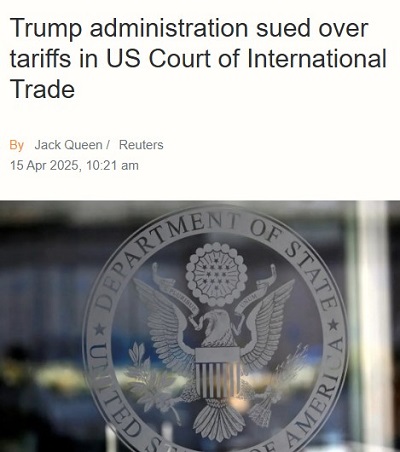
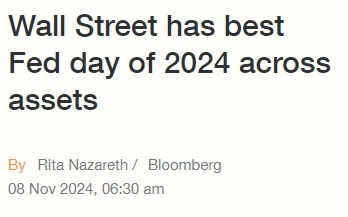
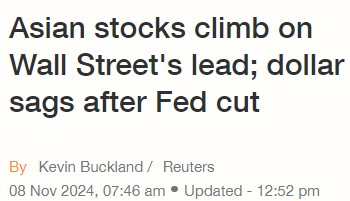
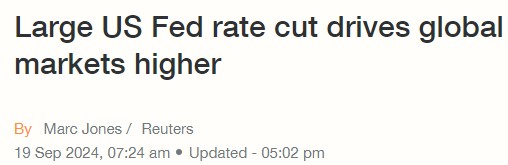
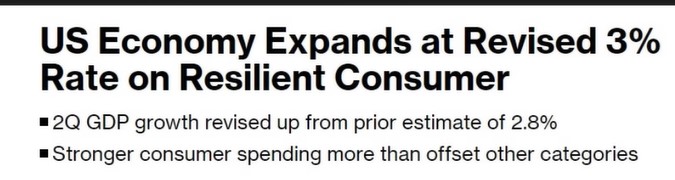
A major one: the Supreme Court struck down Trump’s tariff as illegal. In response, Trump retaliated by invoking a 50-year-old law to impose a global blanket tariff of 10-15%. However, this measure is limited to 150 days. This situation is expected to lead to complications, including refunds and legal disputes. Despite its significance, this event, so far, has minimal impact on your portfolio.
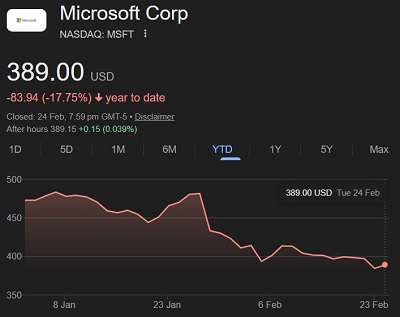
What has a more substantial effect on your portfolio is the release of Anthropic’s Claude co-work agent. This caused a major downturn in a specific segment of the technology sector, with some companies, like Microsoft, experiencing a 17% stock drop YTD.
If your portfolio’s tech exposure declined by 2-5%, I would say that’s like you surviving a Category 10 hurricane and just losing a motorbike, while your neighbor’s house is smashed into smithereens.
Greenland incident cause markets dip, but then it recovered very strongly. Another TACO incident (Trump Always Chickens Out), just like in April last year. Suspect he is manipulating the market – say something outrageous for the market to dip so his friends buy in, then reverses his threat so the market rebounds. Really powerful feeling, I reckon. China’s the only market defying the global selloff, though.
That is also felt in M’sia market when reports stated in the 1st week of Jan, foreign investors turned net buyers of Bursa Malaysia equities with net inflows of RM42 mil. Local institutions extended their buying streak for an eighth consecutive week with net inflows of RM126 mil. Foreign investors extended their net buying streak, recording net inflows of RM716 mil up to mid Jan, the largest since mid-May 2025.
And this sector summary is about why new mobile phones and PCs are about to get pricier, while memory chip makers will continue to do well.
The other notable development is in Singapore’s market – a reform kickstart explaining why it is expected to continue to do well. Again, summarized for you nicely here
quick note to bring you up to speed what happened for the past 30 days
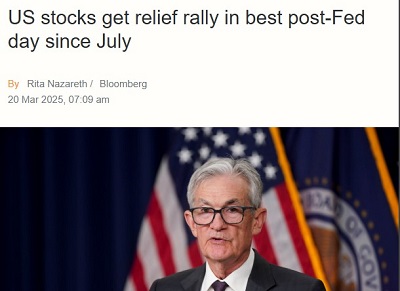
The Federal Reserve’s Further Rate Cut Decision
Imagine trying to drive through thick fog—you can’t see what’s ahead, and every move feels risky. That’s exactly what the Federal Reserve is doing right now. Their decisions about interest rates are creating waves in the US markets with ripples felt by the rest of the markets globally.
Not long ago, the expectation is – Federal Reserve would continue to cut interest rates in December. Now, that confidence has somewhat taken a step back.
The Fed’s voting members are split, and no one knows what they’ll decide. Here’s the catch: the Federal Reserve has 12 voting members, but their recent meeting minutes revealed that opinions are all over the place.
Some want big rate cuts, others want small ones, and many don’t want any cuts at all.
This kind of public disagreement is rare for the Fed, which usually tries to show a united front.
—
Why It’s Happening: A Tug-of-War Between Inflation and Jobs
The Federal Reserve has two big jobs: keep inflation low and make sure people have jobs.
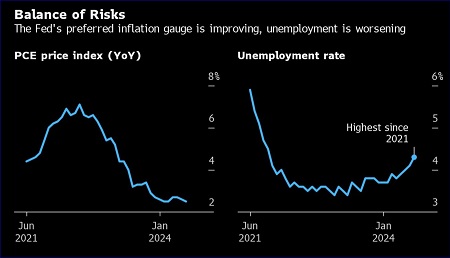
Currently, both are going in the wrong direction.
Inflation isn’t dropping as fast as they hoped, and the labor market is getting a bit shaky.
The unemployment rate rose from 4.3% to 4.4% in September. Plus, job cuts are skyrocketing. In October alone, U.S. companies announced over 153,000 layoffs—a 175% jump compared to last year.
And it’s not just layoffs; more companies are planning even bigger cuts.
I am seeing the ripple effect play out in real time – just this week, a Malaysian couple working in Singapore for the past 15 years engaged me for advisory to explore retirement in Malaysia if they were to sell their 1800sqf home for $6 million, which has appreciated from $4 million since 2017. The trigger event? Husband’s expecting to be offered VSS as soon as Jan next year.
The Ripple Effect: Markets Don’t Like Uncertainty
This uncertainty is hitting stocks, bonds, and even crypt0 hard. One month ago, the odds of a December rate cut were nearly guaranteed. Now, they’ve dropped to just 39.5% according to CME Fed Watch Tool.
Why the shift? The Fed is struggling to make decisions without clear data. The recent US government shutdown caused a 44-day blackout in economic reports. Key numbers like inflation, GDP, and job stats were delayed, leaving the Fed to guess what’s really happening.
A Glimmer of Hope: QT Is Ending
Here’s one piece of good news: the Federal Reserve unanimously decided to stop shrinking its balance sheet, a process called quantitative tightening (QT). Ending QT means more liquidity in the financial system, which is good for all investment assets. But the real game-changer will be their decision on interest rates.
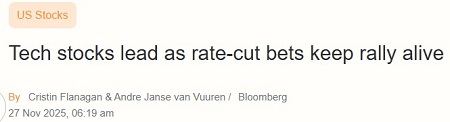
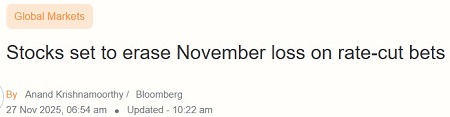
And this week, though, markets rebounded.
Even if the Fed doesn’t cut rates in December, there’s still hope for January. Right now, there’s a 70.1% chance they’ll cut rates at one of these two meetings. And there’s a smaller chance—19.9%—that they’ll cut rates at both.
TL;DR FAQ
Q: Why is the Federal Reserve divided on rate cuts? A: Because inflation remains high, but the labor market is weakening, pulling policy in opposite directions with no clear consensus.
Q: What caused the recent confusion about the Fed’s intentions? A: Vague language in the October minutes, delayed economic data due to US government shutdown, and conflicting Fed member opinions.
Q: How does ending Quantitative Tightening (QT) affect markets? A: Ending QT stops the draining of liquidity from financial markets, providing a supportive environment for stocks, crypto, and precious metals.
Thank you for the support, and I wish you a very nice day. Take care.
Lieu
p.s. –
Keywords and Definitions
Federal Reserve (Fed): The US central bank responsible for monetary policy, including setting interest rates.
Interest Rate Cut: A reduction in the benchmark interest rate to stimulate economic growth.
Quantitative Tightening (QT): The process of shrinking the Fed’s balance sheet by selling assets or not reinvesting proceeds.
Dual Mandate: The Fed’s goal to promote maximum employment and stable prices (low inflation).
CME Fed Watch Tool: A market tool that calculates probabilities of Fed rate moves based on futures prices.
Government Shutdown: A period when US government operations are halted due to funding disagreements, delaying data releases.
quick note to bring you up to speed what happened for the past 30 days
### 1. **Why the U.S. Government Shutdown Isn’t Shaking the Markets**
The U.S. government is shut down since 1 Oct, but guess what? The stock and bond market don’t seem to care.
Even though this is the second-longest shutdown in U.S. history, the market has been climbing for the past 30 days.
Sure, there was a hiccup in mid-October when former President Trump threatened a 100% tariff on China.
But overall?
The market is steady. I know of people who panic sell when this happens.
What they didn’t know is that the market has historically shrugged off government shutdowns. Sometimes, inaction is actually the right action.
### 2. **Earnings Season: Winners, Losers, and What’s Next**
Corporate earnings season is here, and it’s a mixed bag. Big banks in the U.S. are reporting solid profits, but not everyone is winning.
Tesla and Netflix fell short of expectations, which shook some investors.
All eyes are on trade talks between the U.S. and China.
President Trump and China’s Xi Jinping are set to meet. These talks could impact everything from tech stocks to global trade, and the outcome could shift the market dynamics in the short term.
### 3. **Is AI the Next Big Bubble?
AI is the talk of the town, but is it a bubble waiting to burst?
Some people think it’s like the dot-com crash 25 years ago.
But here’s the twist: experts, including Goldman Sachs, say this time is different.
AI companies today are backed by real growth and profits, not just hype.
Sure, there’s always a chance of a bubble, but AI seems more stable and profitable than the tech boom of the early 2000s.
Capture the upside now, so even if it corrects going forward, won’t be in the ‘net negative.’
### 4. **Locking in Bond Yields**
On another note, with interest rates expected to drop, bonds issued from last year up until current ones are becoming more attractive.
Here’s why: when rates go down, bond prices go up. Plus, bonds can offer better returns than just keeping your money in cash.
Why should you care? Locking in today’s bond yields could mean steady income and strong returns, no matter what happens in the economy or stock markets.
### 5. **China’s Stock Market: A Comeback Story?**
Why? Pro-market government policies, rising profits, and strong money flows are driving the recovery.
The fuel behind the surge this year? Ordinary Chinese households, flush with record savings. Total Chinese household savings currently stand at more than 160 trillion yuan ($22 trillion). Retail investors dominate China’s onshore stock markets, accounting for around 90% of daily trading, according to HSBC data.
That’s a sharp contrast with major global exchanges, where institutions lead activity—on the NYSE, for example, individual investors make up only 20%–25% of trading volume.
Naturally high emotions lead to high volatility. But there’s a catch: the U.S.-China trade war could still shake things up. Concentrated and/or rigid exposure is not recommended.
### 6. **Asset Price Inflation to Outpace Inflation Itself?**
Stock markets keep climbing not due to luck—but really due to something called asset price inflation.
When interest rates are low, borrowing money gets cheaper. Companies invest more, grow faster, and make more money.
Some even raise prices, like Apple, Netflix and Spotify, and pass the costs to customers (without losing too many customers, unlike, say, Astro).
With higher profits, companies can buy back their own stock, making shares, perceptibly, more valuable (rise in demand).
Of course, it drops not due to ‘deflation’ but simply due to mass sell-off (massive drop in demand), which is caused by fear & lack of security.
Even if the stock market dipped 20-30% in a broad market downturn (eg 2022), a thoughtfully diversified stock portfolio can always bounce back – just give it time.
After all, there are really not many asset classes to outpace inflation and maintain standard of living, in the long run (> 5 years)
### 7. **The Fed’s Big Moves: What It Means for You**
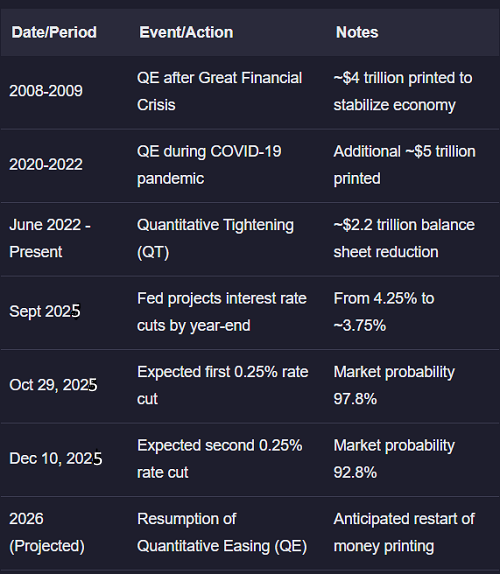
The Federal Reserve, America’s central bank, is shifting gears. They’re ending their “quantitative tightening” phase, where they reduced the money supply, and moving back to “quantitative easing,” which increases it.
Why does this matter? More money in the system can boost the economy and markets.
Reach out to me for further questions. I’ll keep you updated as usual.
Thank you for the support, and I wish you a very nice day. Take care.
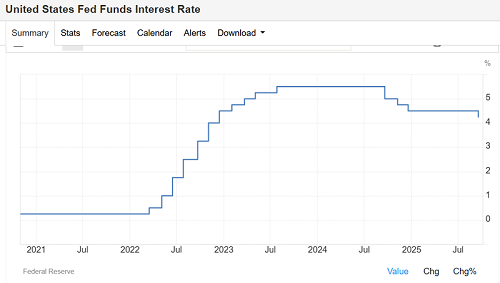
Fed action: They cut rates 0.25% on Sept 17 and signaled two more cuts likely (October & December).
Why it matters: Easing monetary policy by central banks lifts the stock market without fail—and can push consumer prices higher over time.
The details: What just happened?
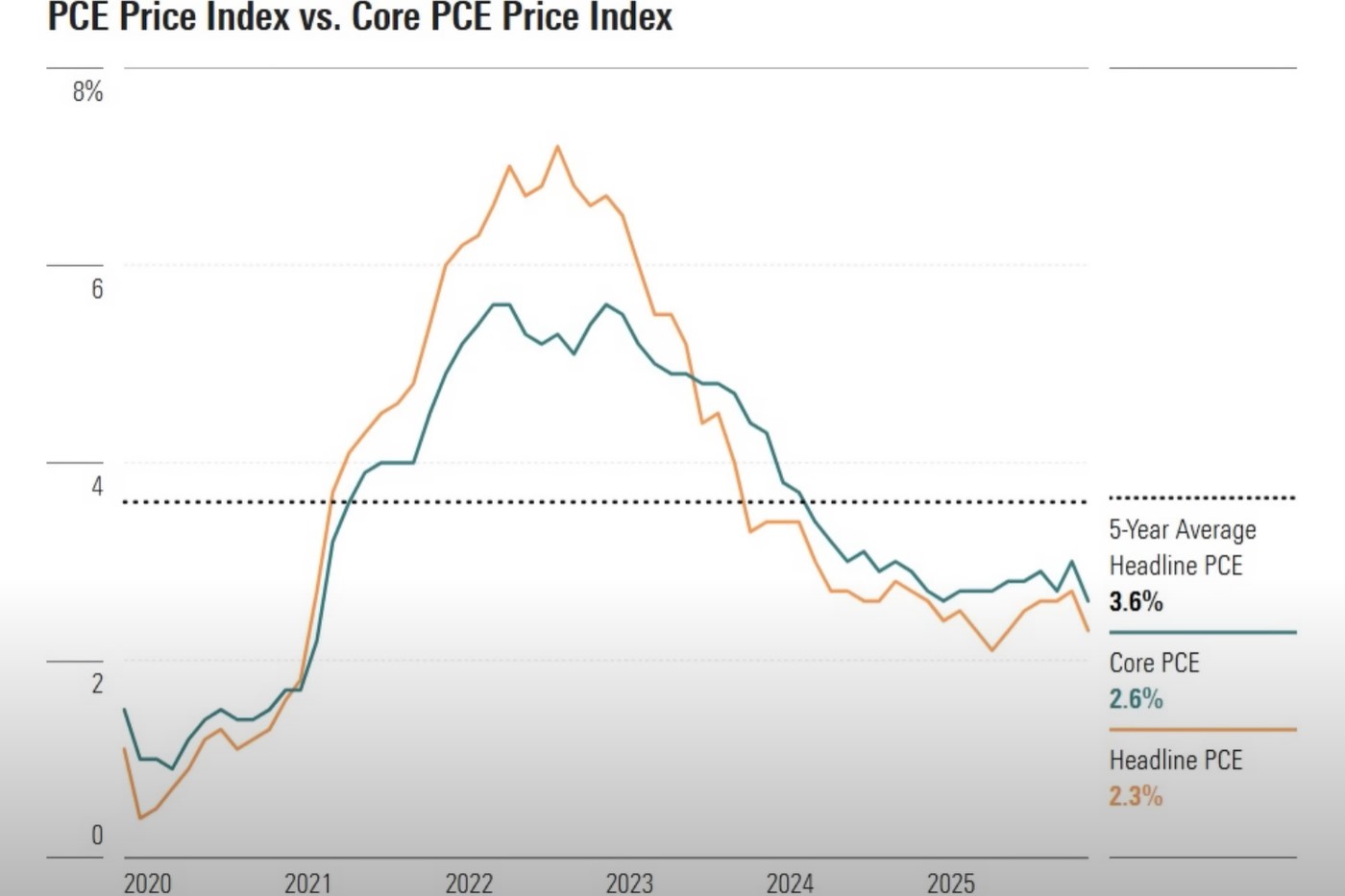
The US government released the Consumer Price Index inflation report. Headline inflation rose a bit to 2.9% (from 2.7%). Core inflation stayed at 3.1%.
The Fed still cut interest rates by 0.25% on Sept 17. That was expected.- The Fed’s forecasts now show more rate cuts this year—likely in October and December. That would push the fed funds rate from about 4.5% down to 3.75%.
Think of this like a car: inflation is the hill we’re trying to coast down. The Fed was braking hard to slow us. Now they are easing off the brake a little—to stop the engine from overheating (the labor market).
Why the Fed is cutting even though inflation is above 2%
Two main reasons:
They think the inflation increase is probably temporary (they used the word transitory).
The labor market is weakening—job revisions showed fewer jobs created than we thought, and unemployment trends worry them. They don’t want a big dip in jobs.
Analogy: If your house is on fire (inflation) but your kid is sick (jobs), you might call the plumber and the doctor. The Fed is trying to balance both.
Producer prices fell—why that helps-
The Producer Price Index (PPI) unexpectedly dropped in August.
Lower PPI can mean less pressure down the pipeline for consumer prices later. That gives the Fed cover to cut rates further.
A few key risks and realities
Easier money = more liquidity in markets. That often helps stocks and crypt0.
History shows markets often move higher after a rate-cut cycle starts. Examples from past cycles:
By year end, after a rate-cut start, markets were up ~77% of the time.
One year out, historical averages showed strong gains (past performance is not a promise for the future).
If markets fall hard (e.g., >20%), the Fed and government will likely act quickly to stabilize things. That usually creates fast recoveries—but not before some pain for leveraged investors.
Simple metaphor: Rate cuts are like giving the economy a sugar rush. Prices (and asset values) often pop up. Too much sugar long-term can cause problems.
What I’m watching right now-
Jobs data and monthly inflation (CPI & PPI).-
Fed communications—are they meeting-by-meeting or on autopilot? They say meeting by meeting, but language matters.
The U.S. dollar direction: a weaker dollar. Money supply trends—more supply tends to lift asset prices and consumer prices over time.
Practical portfolio notes
Not chasing short-term FOMO moves. Markets move fast in these cycles.
Avoid excess margin or overly large bets that could be wiped out in a pullback. Margin is a roller coaster you may not want to ride right now. 🎢
Steady strategy to reduce timing risk in a bullish market = cost averaging and strategic asset allocation
Things are expected to keep on going up, but they are not going to go up in a straight line. So if there’s a correction or a dip, just take advantage.
Reach out to me for further questions. I’ll keep you updated as usual.
Thank you for the support, and I wish you a very nice day. Take care.
Quick updates below, but before that, I want to draw your attention to this TheStar article about Cash Trusts (‘CT’) running rampant in Malaysia:
TLDR version (not my words, but from the article itself):
Promoters of CT products do not provide in detail how they can achieve the (7-12)% guaranteed returns (albeit locked up for X years) that are promised to investors
No fact sheets, no pricing, no monthly, quarterly or annual updates, nor is the ‘performance’ of the CT product explained to investors
Promoters are not licensed or registered with Bank Negara Malaysia or the Securities Commission, although registered with SSM
Agencies and agents that promote CTs are apparently paid commission rates even more lucrative than the insurance industry.
Concern that CTs are big pots of Ponzi schemes, as monies from new depositors could easily be used to pay out depositors without scrutiny ~ big giant bubbles waiting to pop spectacularly
What happened?
The Federal Reserve practically confirmed that they’re going to cut interest rates in September. At its annual events at Jackson Hole, Wyoming, the chair of the Fed, Jerome Powell gave a speech, and in my opinion, as well as market expectation, they will cut in September. Even though we have another month of labor market data and inflation data, it looks like the decision has already been made.
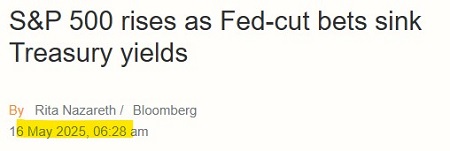
A renewed wave of dip buying lifted stocks, with the US market seeing its biggest rally since May, driven by strong earnings.
Why did it happen?
Context: If inflation is high, then they shouldn’t cut rates. If the labor market is solid, then they shouldn’t cut rates. But if inflation is low, then yeah, they can cut rates. If the labor market is doing poorly, then yeah, they should cut rates.
Okay, but what about this combo?
Inflation is going up, which is a reason not to cut interest rates, and at the same time, the labor market is weakening, which is a reason to cut interest rates.
So how?
I tell you how – it’s going to be a gray area judgment call, which is the situation that they are currently in, and you can be the judge.
Powell’s hint: Although inflation is accelerating because of the tariffs, it is expected that it’s going to be a one-time price increase; therefore, it’s not going to continuously push inflation higher. In other words, short-lived.
What to expect in next 30 days
A 17 September interest rate cut is now the market’s main bet (at times near ~90–95% chances). It’s not guaranteed, but the tilt is towards easing if new economic data doesn’t surprise.
Market implications: Lower interest rates tend to boost technology stocks, making capital cheaper for companies with heavy capital expenditure. Investors also tend to shift into riskier assets, seeking higher returns, boosting valuations of growth stocks. But any hot inflation surprise (especially from tariffs feeding through) can quickly shift the story.
What to expect after 17 Sept (US market, which influences the rest of the global markets)
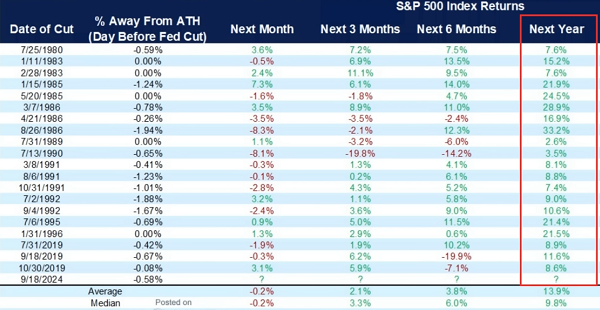
I just want to point this out to you – looking at data since 1980 ~
1 month after the interest rate cuts, the stock market is pretty flat.
Over the next 3 months, on average, the stock market goes up by 2%.
Over the next 6 months, on average, the stock market goes up by 3.8%.
Over the next 12 months, on average, the stock market goes up by 13.9%.
Here’s the trend & probabilities: For the past half a century, 1 month after the rate cuts, the stock market goes higher 45% of the time.
But after 3 months, the stock market goes higher 75% of the time.
12 months out – the market has always gone higher 100% of the time.
Okay, but you know what? Maybe it’ll be different this time. Perhaps the market will go down 12 months after the interest rate cuts.
But my opinion is that I highly doubt that it’s going to be different this time because central banks are printing money like crazy, again. We are in the great melt-up; money supply has been expanding.
I want to point out to you – As we enter another period of easy monetary policy, cutting interest rates is inflationary. Prices inflate, and that includes financial assets.
Cutting interest rates also weakens a country’s currency, so expect the USD not to get stronger.
As I said before (since 2023), interest rate cuts come first, and then it’s going to come the quantitative easing.
Region and sector specific updates
Growing worries that artificial intelligence (AI) tools could soon disrupt the world’s biggest software businesses are sparking a selloff across the sector. Major software stocks, including Monday.com, SAP, and others, saw significant declines as investors fear AI-driven competition could erode traditional software business models.
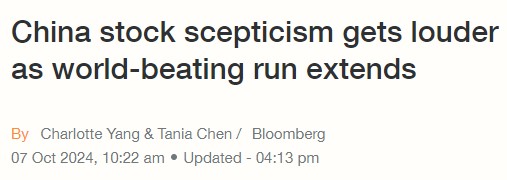
China stocks closed at their highest level since 2015, extending a months-long rally driven by easing trade tensions and abundant liquidity. The Shanghai Composite Index rose furiously, with market capitalization exceeding 100 trillion yuan for the first time. The rally was supported by US-China trade truce extension, Beijing’s policy direction, and fund rotation from bonds to equities.
Overseas investors bought trillions yen of Japanese stocks recently, the most since 2014, as benchmark indices hit record highs. The buying surge was driven by Japan’s faster-than-expected economic expansion, strong corporate earnings, and easing tariff pressures.
REITs Shine as Market Stumbles — What’s Driving Their Momentum?
While much of the equity market has struggled to stay afloat amid global economic jitters, one sector on Bursa Malaysia is quietly outperforming: real estate investment trusts, or REITs. As fears mount over geopolitical tensions — particularly US President Donald Trump’s tariff threats and America’s ballooning trade deficit — investors are finding refuge in this often-overlooked segment.
Just look at the numbers. As of July 23, the Bursa Malaysia REIT Index has climbed 6.2%, reaching 930.59 points. That’s no small feat, especially when the benchmark FBM KLCI has slipped 6% over the same period, closing at 1,529.79. In a market where red dominates the screen, REITs are a rare spot of green.
But what’s behind the resilience? Experts say the answer lies in the defensive nature of REITs — and more importantly, in the steady, attractive yields they continue to offer. In a world of falling returns from traditional fixed-income assets, REITs are beginning to stand out more than ever.
“Yields on Malaysian Government Securities (MGS) and fixed deposits (FDs) have come down significantly,” says one market observer. “But REITs? They’re still offering dividend yields of 5% to 8% — and that’s hard to ignore.”
For context, 12-month FD rates now hover between 2.5% and 3%, while the 10-year MGS yields just 3.4%. That gives REITs a handsome yield spread of around 200 basis points — a compelling case for income-seeking investors.
And the story doesn’t end there. Analysts believe there’s still room for further gains — especially among REITs with solid fundamentals: top-tier assets, high occupancy, and clear expansion plans, either through strategic acquisitions or smart asset upgrades.
What makes REITs particularly appealing in this climate is their predictability. Steady rental income, supported by positive rental reversions, helps provide consistency even when everything else feels uncertain. Plus, lower interest rates mean cheaper borrowing, which translates into cost savings — and potentially, larger dividends for shareholders.
Retail REITs, in particular, are attracting attention. Their domestic focus insulates them from external trade turbulence, and many are expected to post stable or even rising rental renewals — despite tepid consumer spending and the impact of the expanded service tax.
Among the three pillars of the REIT space — retail, industrial, and commercial — retail and industrial are leading the charge. Commercial REITs are more of a mixed bag, often hinging on the location and age of the properties. Office assets, especially older buildings in less desirable areas, continue to suffer from low occupancy and a stubborn oversupply in the Klang Valley.
Retail REITs with flagship malls like Pavilion KL, Intermark, and Pavilion Bukit Jalil are thriving, boasting occupancy rates above 90%. These strongholds are not only popular with consumers, but they also command higher rents — a key ingredient for long-term investor returns. A rebound in tourism further sweetens the outlook.
Industrial REITs, too, are holding their ground, thanks to rising foreign direct investment and the government’s efforts to court both local and overseas capital. Long-term leases, often averaging four to five years, offer stable cash flows and shield them from short-term trade shocks.
All in all, REITs are proving they’re more than just a safe haven — they’re a smart play in a market desperate for clarity. And as long as global uncertainty lingers, don’t be surprised if more investors turn to these income-generating powerhouses.
No US interest rate cut yet (although 2 cuts expected by Dec)
US Central bank ‘wait & see’ stance to see if tariff causes inflation rebound
On-again, off-again trade wars/truce between US & China
All of these uncertainties supposedly, and logically, will rattle global markets.
But surprisingly, markets had been stable, in fact, it had been chugging along for the past few weeks.
Fundamentally, strategists are confident that the Iran-Israel conflict won’t have a lasting impact on stocks and that technology companies — often known for their bullet-proof balance sheets and strong cash piles — will provide shelter should tension flare
Defensive sectors, like healthcare, usually where investors flock to in times of uncertainty, (again) surprisingly, fall out of favor with investors.
So in summary ~
Next event to look out for – 9 July, where, exporting nations without a bilateral accord in place will face Trump’s so-called “Liberation Day” tariffs that are much higher than the current baseline 10% level applied to most countries.
A series of seemingly disconnected but inter-related events that could make you feel ‘disoriented’ if you don’t read it one after another, but I am here to help.
Economy
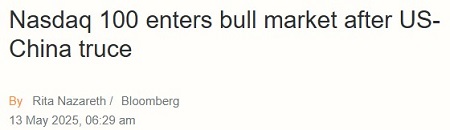
US & China agreed to a massive de-escalation in tariffs, slashing duties on Chinese products from 145% to 30%, and dropping levy on most US goods to 10% for a 90-day period.
It’s like going from a fiery hot sauce to a mild salsa—still spicy, but much more palatable.
The stock market, which had been on a rollercoaster ride, finally found a moment to exhale, much like a parent who just got their toddler to nap.
In the end, both sides left Switzerland with a handshake and a promise to keep talking.
Meanwhile:
Bank of England (UK): Cut interest rates by a quarter point to 4.25% as a response to the global trade war’s impact on UK growth. This decision was a bit of a split among officials, with some wanting a larger cut and others preferring to hold steady.
Bank Negara Malaysia: Kept its overnight policy rate steady at 3% but adopted a more dovish tone, signaling that rate cuts could happen as early as July if the economy slows down. They also slashed the reserve ratio to 1%, a 14-year low, releasing RM19 billion into the banking system to encourage more credit and support economic activities.
People’s Bank of China: Reduced its policy rate and lowered the reserve requirement ratio (RRR) by half a percentage point. This move was part of their efforts to provide ample liquidity and support the economy amid the ongoing trade tensions with the US.
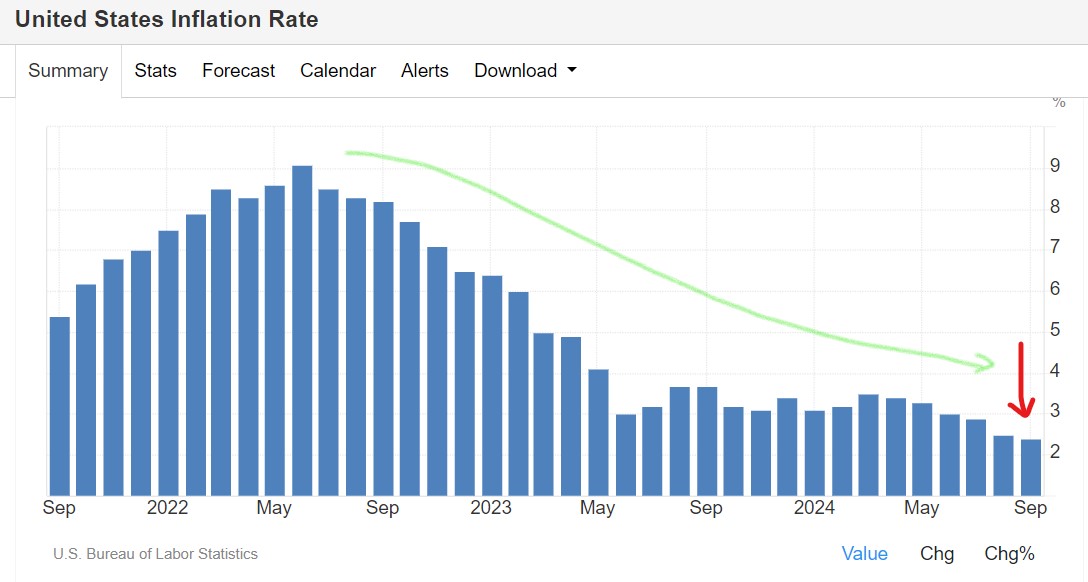
With the latest US inflation rate at 2.3%, lowest since early 2021, the market currently also expects the Federal Reserve to implement 2 rate cuts by the end of this year.
This expectation has been adjusted from earlier predictions, reflecting the evolving economic landscape and trade developments.
Market
Widespread positive sentiment followed the trade truce. US stocks, especially, technology stocks, saw notable gains.
While China’s market rebound was capped by some turbulence due to concerns about Beijing’s lack of urgency in ramping up growth stimulus, Taiwan, Japan and Hong Kong stock markets all rebounded.
Even Malaysia experienced its largest foreign inflow in 15 months, with RM1.5 billion entering the Bursa.
Speed Bumps
Healthcare sector: UnitedHealth Group stocks saw a significant drop of 5.1% after reports emerged about the company secretly paying nursing homes bonuses to reduce hospital transfers for ailing residents. This news impacted investor sentiment and investor perceptions.
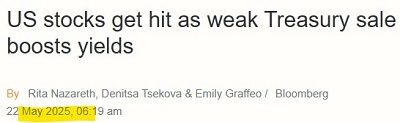
US Gov Bond market sentiment spilling over to the stock market: Moody’s recently downgraded the US sovereign credit rating from “Aaa” to “Aa1.”
This decision was driven by concerns over the US government’s rising national debt.
Moody’s cited the growing debt and budget deficits, along with political polarization, as key reasons for the downgrade.
This move by Moody’s follows similar actions by other major credit rating agencies in previous years, due to 2 key reasons:
Rising National Debt: The US debt has ballooned to $36 trillion, raising negative sentiment about the country’s fiscal sustainability.
Budget Deficits: Persistent budget deficits have contributed to the growing debt burden, with little sign of narrowing.
Adding fuel to fire:
Trump’s ‘Big & Beautiful’ Tax Bill: Recently approved tax breaks included spending hikes. While intended to stimulate economic growth, these measures will significantly increase the federal budget deficit & debt.
Finally, the severity of the impact from the “lower-but-still-higher-before-Trump2.0” tariff rates on corporate earnings is a big unknown for the rest of the year.
For context, before 2025 ~
US Tariffs on China:
Started with 25% tariffs on about $50 billion of Chinese goods in mid-2018
Include consumer goods, electronics, and industrial products
Tariff rates varied by product category, ranging from 7.5% to 25%
China’s Tariffs on the US:
China retaliated with tariffs on approximately $110-185 billion of US exports
Include key US exports like soybeans, automobiles, aircraft, and other agricultural and manufactured goods
1) What Really Freaked Trump Out, Made Him U-Turned
It wasn’t the stock market that made him pause the tariffs, but rather the drop in US government bond prices.
These bonds are crucial because they help the government borrow money, and they’re usually a safe haven investment.
Typically, during economic uncertainty, investors flock to government bonds, pushing up prices, but this time they didn’t (an anomaly)
Instead, US gov bond prices fell, signalling deteriorating confidence in Trump’s policies.
This unusual situation worried Trump and his advisors. It wasn’t just about the stock market; it was about the entire financial market reacting to his actions. Upending the stability of the entire markets contradicts with his promise to “Make America Great Again.”
Trump’s 90-day tariff pause wasn’t due to other countries begging him for negotiation; it’s because he was alarmed by the US gov bond market’s reaction.
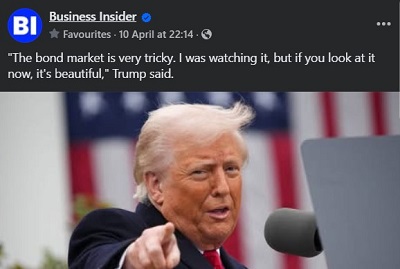
He admitted to watching the bond market closely, calling it ‘tricky’ and then ‘beautiful’.
But believe me, I watched most of his The Apprentice reality shows 20 years ago and I tell you, in Trump’s attention-seeking dictionary, that means:
“I just pissed my pants, but phew, glad I didn’t sh!t further”
Global stock markets may sway to Trump’s mood and whims, but the US Gov Bond market showed him who the real boss is.
2) Who’s the Real Loser (and Winner) so far
Trump’s real aim was to manage US government debt and push for lower interest rates before refinancing it.
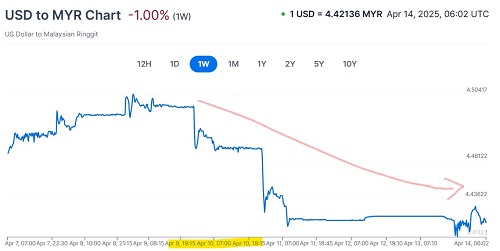
However, with investors pulling out or not flocking into US gov bonds, the dollar weakened in a knee-jerk reaction, against major currencies (Euro, swiss franc) and even vs minor currencies like Ringgit.
He found himself in a precarious spot, similar to the UK Prime Minister Liz Truss in 2022, who faced backlash for her tax-cutting policies. She stepped down amid a GBP and UK gov bond crisis, making her the shortest-serving prime minister in British history
In other words, this was Trump’s ‘Liz Truss moment’: when what he thought was an economic bravado meets (bond) market reality.
The difference is Truss was forced by the Parliament to step down, Trump got away with it (so far).
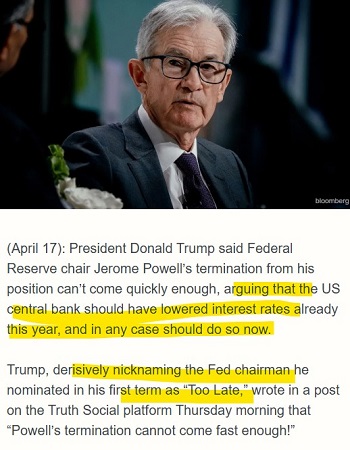
The other thing you might fail to see is that he’s actually in this war of attrition, or standoff with the Federal Reserve and Jerome Powell.
Remember how he promised to cut down US debt? Well, he can’t just do that out of nowhere. He wants to refinance it at lower interest rates, which is why he’s been pushing for rate cuts on his Truth Social, multiple times.
He knows the Fed can’t afford to just allow the economy to fall into recession, so he’s trying to threaten, ahem, pressure, them indirectly with these tariffs, hoping they’ll make an emergency rate cut like during COVID.
But so far, nothing from Powell (he’s just chillin’), and really, in this battle with the Fed, he’s losing.
Man of the Hour – who stood up to the bully’s name-calling
Trump is the loser. It’s like he was bluffing in a game a poker with Jerome Powell and last last he folded la.
Trump thinks he’s ‘winning’ with tariffs as he called it “negotiation” while it was really just a humiliating Uno-Reverse.
So, round 1: Jerome Powell=1 Donald Trump = 0
Moreover, if the intention is to really pressure China, he got to ask himself – ‘are my trump cards (pun intended) more powerful, or at least as powerful as Xin JinPing’?
End of the day, you don’t back down on your threat with ‘exceptions’ when you have ALL the trump cards unless the other party make you a Godfather offer, yes?
No exceptions.
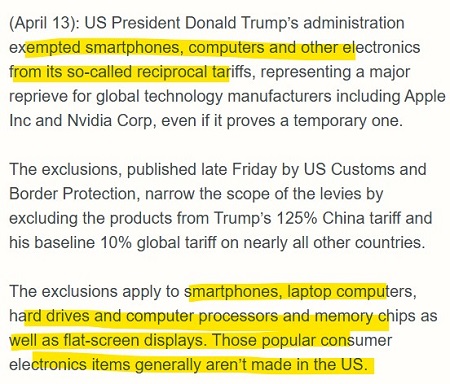
However, by the end of last week, Trump flinched again with this:
One thing for sure, the lobbyists working for US tech companies are literally camping now at Washington.
Nothing inherently ‘evil’ about a country having a trade deficit. It simply means US consumers are purchasing more from the rest of the world than the world is buying from US.
Also, the trade deficit only considers tangible goods, NOT services.
You see, who are we paying money to when…
we watch Netflix?
we listen to Spotify?
we watch a Hollywood movie at cinemas?
we pay to subscribe to SaaS like Microsoft Office?
we pay to run ads on Google/FB?
we pay for children’s education in US colleges?
Do you agree these are US-based services we pay for, some on a recurring basis? This fact has been entirely disregarded.
Chinese saying – Barking dogs don’t bite, silent dogs will.
Round 2: Xin Jinping = 1 Trump = 0
3) Reshoring Trump Card or, Delulu is the Solulu?
The US has long encouraged global trade, leading to manufacturing being outsourced to countries (China, Vietnam, India, Msia etc)
This was a strategic move post-World War 2, allowing the US to focus on services rather than manufacturing.
Shifting manufacturing industries would take years, and by then, political leadership would have changed, altering policies again (you think Trump won’t turn senile like Biden, or he’s an immortal?)
This constant change makes the idea of relocating manufacturing impractical and disruptive.
Companies like Apple, which rely heavily on global supply chains, would face enormous challenges moving manufacturing back to the US.
“There’s a confusion about China. The popular conception is that companies come to China because of low labor cost. I’m not sure what part of China they go to, but the truth is China stopped being the low-labor-cost country many years ago.
And that is not the reason to come to China from a supply point of view.
The reason is because of the skill, and the quantity of skill in one location and the type of skill it is… The products we do require really advanced tooling, and the precision that you have to have, the tooling and working with the materials that we do are state of the art.
And the tooling skill is very deep here. In the U.S., you could have a meeting of tooling engineers and I’m not sure we could fill the room. In China, you could fill multiple football fields…”
(To minimize exposure to China’s 104% tariffs, Apple has been increasing iPhone production in India, especially since the China’s 0 c0vid policy), Despite India’s own 26% tariff, it remains a more affordable option compared to China)
4) Trump Wants More Factory Jobs, Americans Want Meh?
Also, at the core of this vision is a romanticized idea:
American workers are waiting and willing to take back the factory jobs that were once outsourced overseas.
Reviving U.S. manufacturing, however, is colliding headfirst with economic reality.
Americans aren’t eager to return to factory work.
Even now, US manufacturers face worker shortages.
According to the Census Bureau’s Quarterly Survey of Plant Capacity, 20% of U.S. manufacturers still cite a shortage of available workers as a key production constraint.
Trump conveniently disregards this fact while being delusional about Americans looking forward to working in mind-numbing manufacturing lines to screw tiny nuts and bolts into iPhones.
It directly undermines the administration’s logic for undoing the post-World War 2 trade framework. Nothing but a political fantasy?
5) Collateral Damage & Reality
From an SME/SMB standpoint, imagine this – you are a biz owner in the US ordering $50k worth of goods from China factory, and no, it’s not because you didn’t try to place order with US factories – it’s simply no US manufacturers able to deliver what you asked for.
With 100% tariff, you need to pay an extra 50k to US customs when your order arrives in US soil on top of the 50k you paid China supplier.
Your profit margin? Nil or negative.
If you don’t accept your order, what are you going to do? Send it back to China? You still need to pay a shipping fee, and you have nothing to sell at the end of the day.
Dispose of it in the Pacific Ocean? You just burn 50k for nothing.
Lose-lose situation.
In fact, US businesses are already feeling this – like the point of the tariffs is NOT to help businesses, it’s NOT even to invest more in the US — it is to fill US gov coffers.
After all, US SME/SMB can’t afford to do this, can they? 👇👇
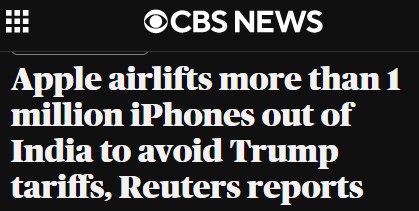
An apple a day might keep the doctor away, but Tim Cook is hoping a few planeloads of them will keep tariffs at bay.
Oh, one thing for sure now, lawsuits.
If he continues down this path, he may worry more about losing political support, then later funding support, before you need to worry about the markets not rebounding.
This is a self-inflicted market uncertainty/black swan caused by US gov itself, not by systemic issues within the economy (subprime mortgage crisis, dotcom bubble, SVB and credit suisse collapse) or rogue market manipulators (yen carry trades, Archegos’ Bill Hwang).
Rgds,
Lieu
p.s.
Tariffs are essentially taxes on imported goods, and nobody likes paying extra taxes.
For countries, it means paying more for foreign products. Sort of like a penalty.
If done for the right reason, it makes sense – similar to what Malaysia did in the 80s to protect the local automotive industry, Proton in its infancy stage.
In the current scenario, it’s an utterly moronic tax imposed just because a 78 yo orange haired moron has mood swings in the White House.
In fact, if he wasn’t the President, what he’s doing would be straight-up market manipulation.
The market had this huge rally when he announced the pause, the biggest since 2008. If he wasn’t President, he’d probably be investigated for it.
I know people in Malaysia working for companies that ship electronics to the US, and they were scrambling to figure out how to deal with the tariffs.
They paused shipments and worked overtime to plan moving manufacturing to the US to dodge the tariffs. But then, all that work was for nothing when Trump paused the tariffs.
Imagine if you were one of those staff and you had the guts to say,
“Hey, don’t worry, this guy’s a moron la, he’s going to change his mind last moment, trust me.”
You’d look like a genius now.
Next 90 days?
If you are a biz owner exporting to or operating in US, you’d be asking – “How can you make major decisions and investments when you just don’t know if what’s true today is true tomorrow?”
It’s like a scenario where you confess your love to the person you have a crush on, and (s)he keeps you hanging.
Neither saying ‘Yes’ or ‘No’ – keep you in limbo – “See How la!”
Trump is gaslighting everyone…on a global scale.
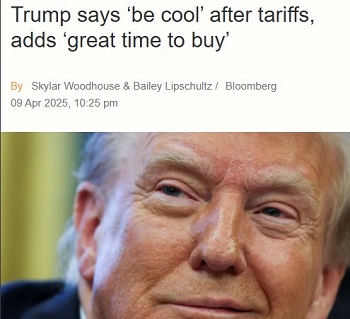
Great time to buy (or not) depends on your personal circumstances
💪 Mexico, Canada & China (and potentially more countries) responded by saying “We’ll retaliate”
Global markets Down: 📉
⏳ 30 days later,
a) Trump gives ‘Temporary Extension’
Global markets up again: 📈
Or
b) Trump follows through with his threat
Global Markets Down again: 📉
👉 When (b) happens,
⚔️ Mexico, Canada & China and co retaliate with their own tariffs
😡 Trump, not to be outdone, doubles tariffs as ‘punishment’
Global markets go back down 📉
🤝 24–48 hours later, a temporary ‘truce’ is reached
Global markets go back up 📈
===rinse and repeat===
Central bank chips in to calm the markets with some ‘magical words’, short of any action so far (nonetheless, it worked!)
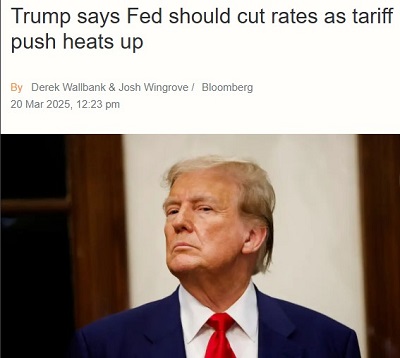
Trump, on the other hand, who hates to be out-of-the-spotlight, had this to say:
Because he knows if tariffs are here to stay, then the Fed’s interest rates and the monetary policy easing going forward will likely act as countervailing forces to his tariffs’ policy.
The other countervailing forces to avoid stagflation or reflation (re-emergence of high inflation) are, ironically, Trump’s other pro-business, demand-stimulating policies such as deregulation, bringing back US industrial capacity, and both corporate & personal income taxes cuts.
Corporate Earnings
Not particularly concerned on tariff impact on US corporate earnings because tariffs get passed through to end consumers as inflation (think of VAT or GST).
Prudent to maintain exposure still due to the fact US is still being the world’s biggest economy, although no more heavy exposure into US Megacap stocks – but instead, into small-midcap space – healthcare, industrial, consumer etc.
Historically, there had never been a recession from policy uncertainty itself.
10% corrections usually would not worsen into 20% bear markets unless they’re accompanied by either a flash recession, mass earnings drop, sharp decline in consumer confidence or a Fed hiking cycle.
APAC & Malaysia market
AsiaPac market, in particular, led by Hong Kong/China, turned out to be the winners from Trump’s first 3 months in office.
Especially the tech sector – with Alibaba’s biggest beneficiary of the sector recovery, unveiling its own open-source AI model (Qwen) and $53 bil capex into AI infrastructure.
Global investors’ confidence is shifting to AsiaPac markets. The sentiment is bettering with China’s assault on US for AI dominance. Xi Jinping’s crackdown on China’s tech sector is over.
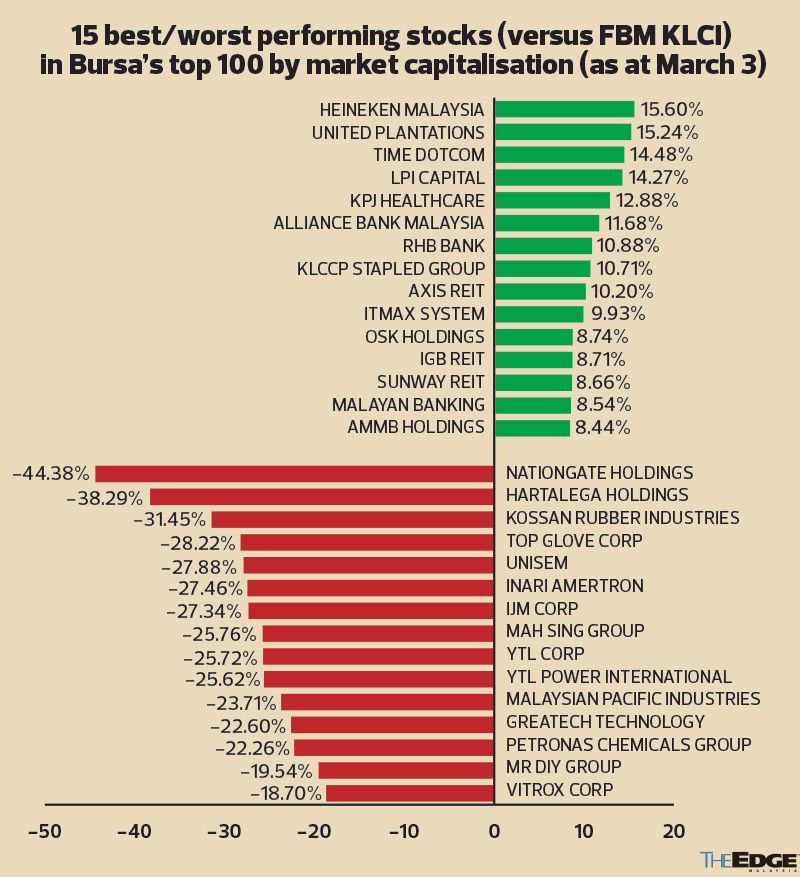
In Malaysia, Government-linked funds and financial institutions provide a safety net, and are snapping up shares like Shopee 11.11 sale.
FYI, here’s some misconception even the most veteran investors have on stocks dividends or any high income/dividend equity funds.
Dividend Fallacy
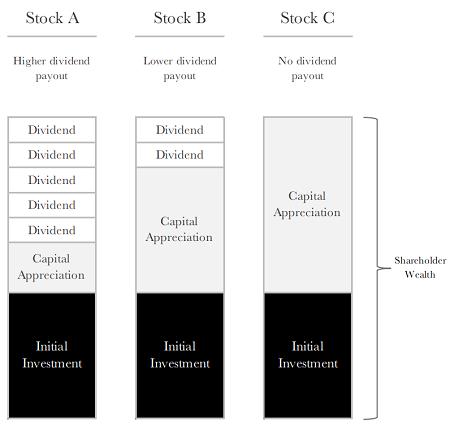
Contrary to popular belief, dividends aren’t an extra return on your investment—they are a return of your principal.
When a company issues a dividend, what investors don’t realize is that stock prices do adjust down for those dividends that are paid.
Hence, any “bonus” a dividend provides is canceled out by the corresponding decline in the stock’s price.
That makes dividends a piece of your total return. But they are really only additive to total returns if reinvested.
A company’s dividend policy is intentional and strategic; it boils down to an attempt at meeting shareholders’ expectations.
Because a profitable company can either:
Return earnings to shareholders via dividends (or stock buybacks), or
Retain earnings and reinvest them to grow the business, or
Do a bit of both.
Therefore, owning a portfolio of dividend stocks or a high income/dividend equity fund that pay more (less) in dividends is not innately better (worse) for an investor’s portfolio
Analogy
You and I are given one 12 inches pizza each.
I decided to cut my 12 inches into 6 slices and stack them together.
Do you agree that visually, it seems like my 12 inches pizza has ‘shrink’ into a stack of triangle, but I still have the same amount of pizza as before?
What if I tell you that now I have more pizza than you because I have 6 pieces, while you only have 1 piece of uncut 12 inches pizza?
You would call me crazy!
No Guarantee
There is no guarantee that dividends will be paid to shareholders just because the company historically pays a dividend.
Companies have no obligation to pay dividends to shareholders.
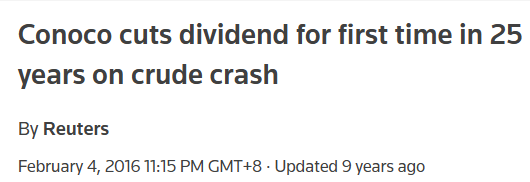
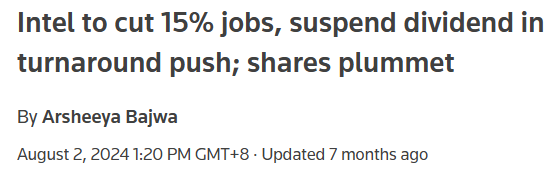
In fact, companies have the right to cancel, alter or delay dividends at any time without reasoning.
When companies seek to cut costs and hoard cash to survive a crisis, dividends often end up on the chopping block.
Bond Coupon is Different
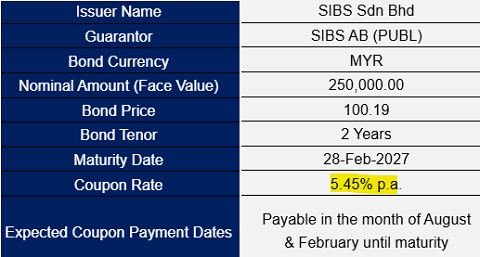
Unlike stock’s dividend, bond coupon is guaranteed as the company is obligated to pay the promised %. Failure to pay means a default incident.
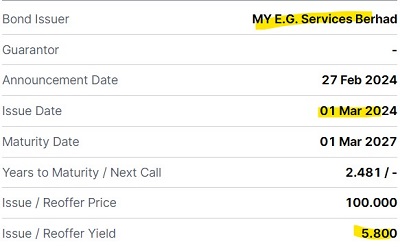
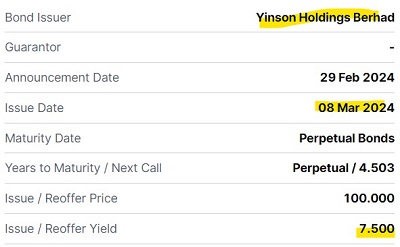
Coupon rate, once finalized during issuance, just like a real, current example below, can’t be canceled, altered or delayed even it is facing a cash crunch/crisis.
Bond price does not adjust down due to coupons payments.
Even at institutional level like M’sia’s EPF or Singapore’s GIC, people thought the ‘income’ generated comes from its dividend stocks. But actually, if you look at their asset allocation, most of the ‘income’ comes from its bond portfolio – not from its equity portfolio.
Examples
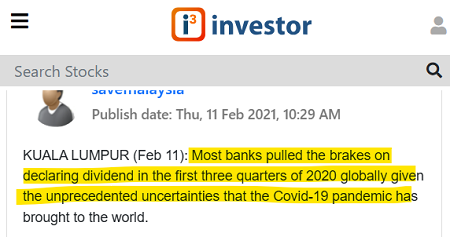
Take 2020 (bad times). As COVID-19 spurred widespread lockdowns, cash-strapped companies slashed dividend payments globally from April through December.
Even in good times, companies can stop paying dividends due to internal and external crisis, a telling reminder that the dividends income investing strategies target are neither a bonus nor a guarantee.
Certain sectors though, like Real Estate Investment Trusts (REITs) actually pay distributions, not dividends. While distributions look and act like dividends in many respects (investors see cash arrive in their account every month, quarter, or half-year), these payouts are, in fact, quite different.
REITs get very favorable tax treatment, essentially paying no corporate income tax — so long as they distribute a huge percentage of their earnings. This standard of high payouts is ingrained in the sector’s corporate structure
Dividend Traps
How dividend yield is calculated—
(Latest yearly dividend per share of the stock divided by the share price)
However, if that share price starts to go down because the denominator is getting smaller and smaller, the resulting yield will be higher and higher.
Green Flag: If you see a high-yielding stock, it could just be a great company that’s paying out a lot of its earnings as a dividend, and it could be a good investment.
Red Flag: It could also be a company that has seen its yield being pushed up by declining share price.
That declining share price might represent some negative fundamental challenge to the company’s business model, and it might even indicate that there’s a dividend cut coming in the future.
So, buying on dividend yield alone can be a dangerous strategy. This is like you investing into a property just because the property developer has GRR – Guaranteed Rental Return for you.
Lieu
p.s.
None of this means high-dividend stocks are inherently bad, but they aren’t special, either.
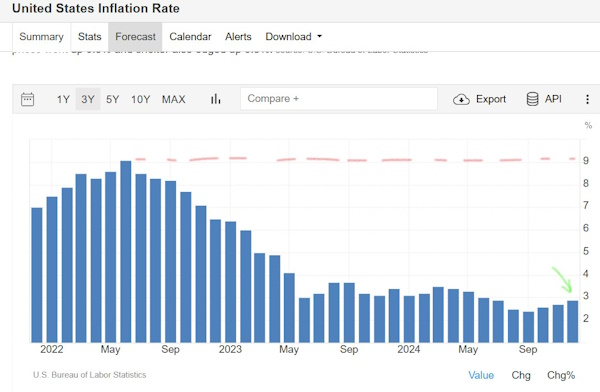
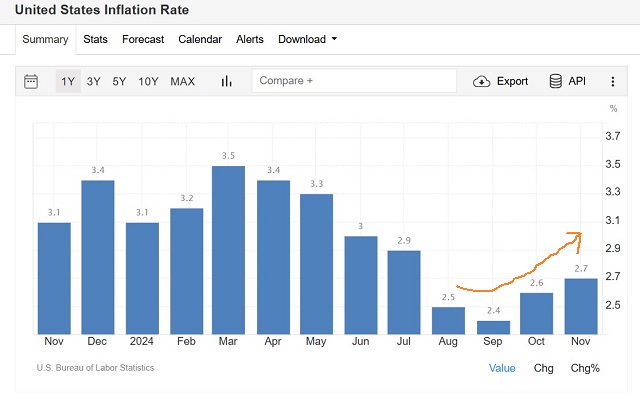
The U.S. Consumer Price Index CPI year-on-year increase was 2.9 percent in December 2024, a slight increase from November.
It has been stagnating at levels slightly higher than the central bank’s target 2% over the past six months.
However, we’re definitely in a better spot than those 9% highs 2 years ago.
Market reaction
After this CPI inflation report, the stock market shot up.
The market was expecting worse (higher) inflation numbers, so when it wasn’t as bad as feared, it gave a little boost.
Plus, banks are reporting strong earnings for Q4 2024, which is adding to the positive market sentiment.
Expectations for the next US Central Bank meeting
The wide expectation is no rate cut for the next US Central Bank meeting on 29th of January. Last year, from September to December, the Federal Reserve cut interest rates three times, a total of 1%.
This year, one or two more rate cuts are expected, but if the economy stays strong and inflation stays where it is, the rate cut will likely be just once or twice.
US as a benchmark
The U.S. economy is a big player globally, so what happens there affects markets in Japan, China, Europe, and beyond.
Economic outlook
Right now, the economy seems strong, and inflation is relatively contained. With Trump coming back as US president, there’s some anticipation that things might improve further.
It would be better to have a strong economy with rising corporate profits that results in slower rate cut going forward, rather than an economy that slows down rapidly and the central bank has to resort to cutting interest rates in a fast and furious manner.
The data does not point to a situation where the economy is overheating and inflation is accelerating, explaining why markets rebounded after the inflation report.
Outpacing inflation
Just a quick note on investments: equities tend to go up in the long run, not because they’re magical, but because they can outpace inflation.
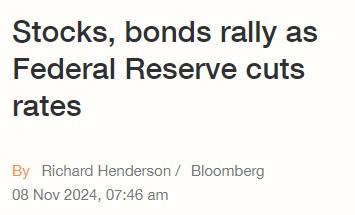
Markets declined this week after the Federal Reserve cut interest rates by 0.25%, bringing the rate down from 4.75% to 4.5%.
This cut was in line with market expectations.
New 2025 interest rate cut forecast
The Federal Reserve also shared a new projection for 2025, which has changed compared to earlier projections from 3 months ago.
The new forecast for 2025 is for only one or possibly maximum 2 interest rate cuts, bringing the rate from the current 4.5% to 4%.
In other words, slower pace of rate-cutting.
Reasons for the market reaction
Contrary to the usual post-rate cut trend, the market reacted with a sell-off because it is forward-looking and had expected a more aggressive pace of interest rate cuts in 2025.
The overwhelming bullish sentiment spilled over since Trump’s victory last month was somewhat dampened by the new forecast.
Overnight, that sentiment spread across all global markets, M’sia & Asia included.
No sectors were spared, just a matter of magnitude of the decline.
Nonetheless, to put things in perspective, your portfolio captured these back in November.
Inflation remains above 2%
The Federal Reserve started the interest rate cuts 3 months ago even though inflation had not reached their target of 2%, although it is ‘close enough’.
Why?
To meet public expectations and support businesses, that’s why.
Since then, inflation has been silently creeping back up.
The Federal Reserve is trying to stimulate the economy and avoid a recession without reigniting inflation, which has made their task increasingly complex.
Trump’s policies and approach to US market
Trump’s policies, such as imposing tariffs and bringing manufacturing back to the US, could lead to increased costs for consumers, potentially causing inflation to rise.
If persistent inflation rebounds like a cancer relapse, the Federal Reserve would have less motivation to continue cutting rates rapidly.
Trump’s approach to the stock market
Now, here is where it gets interesting.
Trump has always taken credit for stock market rallies and takes US stock market returns during his first term as his proud scorecard.
So, even though his economic policies isn’t ‘market’-friendly’ as it contradicts any sane effort to prevent an inflation rebound,
…he is unlikely to tolerate a declining stock market during his term as president.
What he said (or rather, threatened) is to be taken seriously, yes, but not always literally.
Expectations for market volatility
The decline in the stock market is expected to continue until January when Trump officially becomes PoTUS.
Tax loss harvesting among institutional investors could also contribute to the volatility.
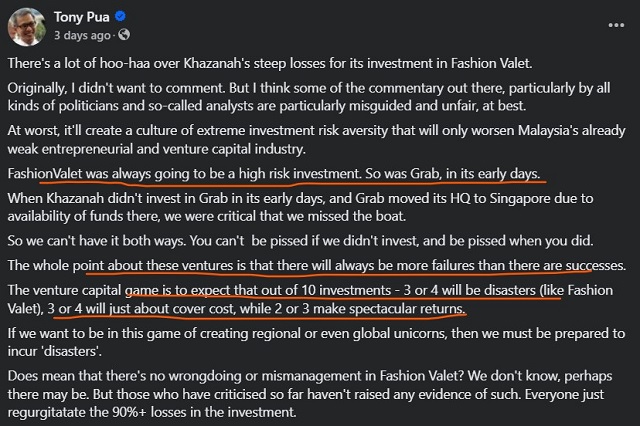
Believe it or not, , Tony Pua actually made the most technically sound commentary on this incident.
M’sia politicians are known to make absurd remarks, but Pua is one of outlier I respect (not for his other controversial comments though).
From a layman’s POV, why would you invest into a loss-making company?
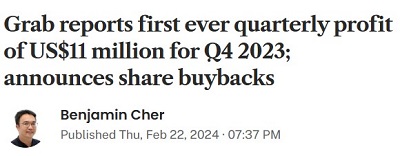
Now, for comparison, bear in mind Grab was still a loss-making company when it was public listed in 2021, only in Q4 2023 it made its first profitable quarter.
For any VC/PE investors, profits aren’t made hinging on the company being profitable. Instead, it is based on valuation.
A startup valuation goes up by raising more funds with the hope of future prospects. This inevitably makes startups notoriously difficult to value accurately, especially unprofitable ones.
The thing about valuation is this – it’s all about stories. Every startup management convey their company’s story to the investor community, some buys it (like PNB & Khazanah in Fashion Valet, FV case) and some don’t.
The one who buys into the story, defines the value of a company.
All you need is a reasonable basis to back your revenue or profit projections.
And that’s what any start-up founder tries to do – continue to tell more (and hopefully better) stories, backed by numbers, to raise more money (Carsome, anyone?)
Although, having no profit doesn’t necessarily mean they don’t make money. Many startups do have revenue, but they intentionally invest most of it to grow quickly.
And revenue alone isn’t enough, so they pitch more and often times, bigger investors to invest more money to accelerate that growth.
They try to outspend their competitors, growing in market share. It’s the idea of winners-take-all.
Achieving profitability is only something to do later. You first grow, take all the money you have and invest it to scale, hoping to take a big enough part of the total addressable market. It’s a very long-term strategy.
Again, Grab followed this playbook to the tee.
For FV, you can read this 2017 article by TheEdge before the GLICs invested – where the founder said – “Our goal is to try to be like the LVMH of Southeast Asia”
That is a good story, yea?
I’m not saying this path of running a biz is financially prudent or sustainable – and you may disagree with this but I’m just explaining how reality works.
Tony Pua and Aireen Omar (Capital A president) understand this, but she got a lot of flak online for how she condescendingly explained it in a podcast.
As of up to FY 2023, FV racked up retained earnings of -RM127mil. Retained earnings are a firm’s cumulative net earnings or profit after accounting for dividends. Negative means that FV has not made profit since the inception of the business, but presumably it didn’t affect the founders’ high-flying lifestyle in any way.
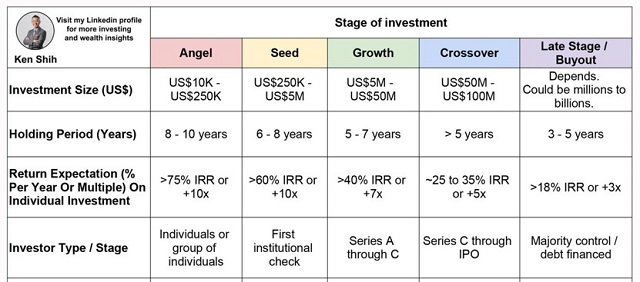
How Venture Capital (VC) & Private Equity (PE) profits are made
I give you a layman example – you invest 100k into a company while it was valued at 1 mil for a 10% stake. 5 years later, the company is valued at 20 mil.
Your 10% stake is now worth 2 mil on paper. When you do cash out, that’s 20x return realized.
On the flip side, if you invested 1 mil into a company valued at 10 mil for a 10% stake, then valuation drops to 5 mil, your 10% stake now is worth 500k (down 50%), on paper, and loss realized if you cash out.
The only thing I am not sure is whether the GLICs treated the 47 mil investment in 2018 as VC or PE. Coz from holding period POV, it mimics PE but from investment amount POV, it mimics VC.
Side note: Khazanah did strike gold with Farm Fresh, the well-known local milk brand. 20 mil seed capital invested in 2011 for 30% stake over 11 years before IPO – worth about 1.1 bil by IPO time. This homegrown success story yielded a whopping 54x return, showing that VC/PE investments do bring monumental returns.
Another side note is – Temasek wrote off over $ 270 mil of its VC investment into crypt0 platform FTX which turned out to be a complete Ponzi scheme.
Cashing out
If you wonder why PNB & Khazanah sold their 47 mil stake at 3 mil (aka divestment), it could be the mandate is to cash out after X duration holding period, regardless of profit or loss.
Hypothetically, they can choose to hold on to their stakes in FV for say another 3y, and by then only cash out, say 50 mil collectively (3 mil profit vs cost) if FV able to turnaround the biz, hence upping its valuation in 3 years time for IPO.
But they most likely know something we don’t (“no hope already, so to be a responsible, exit lo”) or can’t wait that long (due to internal mandate).
Therefore, they decided to sell their stake to NXBT, a private investment firm owned by timedotcom CEO in a secondary market sale.
Most people think company going for IPO is the only way, but now you know secondary market sale is also another.
For IPO though, VC/PE investors might be subject to a period of lock-in post IPO before they can cash out entirely, and if the general market is down, it may deter them from cashing out immediately.
The Dark Side of Raising Capital
Dodgy things happen when the startup founders use investors’ money for purposes other than growing and scaling the business.
And that is precisely what MACC just found up after raiding the GLIC offices, FV offices and the founders’ houses.
Because the founders are socmed influencers who are not shy to flaunt their luxury possessions online, that becomes their nightmare now as MACC said:
‘we believe that there are some investments that have been misused in this matter, which we are identifying’.
Their bank accounts are frozen and “11 handbags and a luxury branded watch with a total estimated value of about RM200,000 were seized”.
If you ask me ho, aiya, this level of ‘luxury’ is nothing compared to Rosmah’s la. Kacang putih only.
So moral of the story is – flaunting your wealth in the public can bite you back in the future. Keep low profile when you have money.
Until then,
CF Lieu
p.s. For the rest of the public markets:
This month’s comment is
“Walk on, nothing to see here after Trump’s victory. “
Sentiment’s positive so far, triggering a cross-asset rally, esp after the Fed rate cut another 0.25% as expected per what I updated you earlier.
Interesting development for MREITs – 2 big groups are planning to list their REITs, namely, WCT Holdings Bhd and S P Setia Bhd.
WCT is set to establish a new REIT called Paradigm-REIT, which will include three retail properties valued at RM2.4bil. The listing is expected to occur on the Main Market of Bursa Malaysia by 1Q25, with WCT retaining a 60.7% stake in the new entity.
Property developer S P Setia has plans to inject its investment properties into a REIT within the next 12 months, with a valuation of RM1.3bil to RM1.5bil. It has been speculated that IOI Properties Group Bhd may also establish a REIT, given its increasingly mature investment properties portfolio.
These new listings are expected to spur investors’ interest. Additionally, lower interest rates are attracting property funds to invest in more real estate assets. This is expected to drive overall asset values higher. Overall, a more active real estate market can be expected in 2025.
The uptrending demand in industrial REITs is also expected to continue since the last 4 years, due to the US-China trade war and post-Covid-19 pandemic recovery. The influx of data centres is also pushing up industrial properties as Malaysia becomes a hotbed for new data centres.
Bursa Malaysia could see the entry of new DC REITs. It may take a couple of years as acquiring a data centre asset also requires major fundraising, likely over RM 1 billion.
US and the world – what is happening
In my last update, I mentioned –
Anything interest rate cut higher than 0.25% rate cut every 3 months (quarter) can signal a perception that the economy is heading towards a recession/hard landing.
The Federal Reserve blew past everyone’s expectation when it kickstarted interest rate cut cycle with a bang – double of what was expected – 0.50%, and the ‘bad perception’ did not happen.
In fact, the opposite happened. The case for strong US economic growth got a boost in the right after the cut, after job market data came in far above expectations and inflation data dropped to the lowest so far since 2022.
Dual-mandate central bank will only cut interest rates faster or deeper if it needs to rescue one of these: the economy, the job market or the stock market.
But all the data on these 3 are reported as good, so essentially, nothing needs rescuing.
Nonetheless, the central bank is proactively easing monetary policy without waiting for genuine economic weakness.
The classic investing playbook for when rates are coming down is to allocate stocks in sectors that are considered defensive in nature because their demand is impervious to economic conditions, like healthcare & utilities.
The reason is the central banks typically lowers borrowing costs (cut interest rates) to fight off a weakening economy or boost one that’s already sunk into a recession.
During those periods, companies in growth industries like technology tend to suffer.
But that isn’t happening now. Rather, the economy is growing, and stock indexes are recovering from their 2022 lows; there’s no playbook to refer to for such environment.
China – what is happening
in a major sentiment shift sparked by Beijing’s drive to reverse its economic slowdown and revive interest in China stock markets.
Chinese stocks capped their biggest weekly rally since 2008 with a burst of trading that overwhelmed the Shanghai stock exchange, underscoring a dramatic shift in investor sentiment after Xi Jinping’s government ramped up economic stimulus.
Trading activity was so intense that it led to brokerage system glitches and delays in processing stocks orders.
China – Why is it happening
After China stocks endured 3+ years of losses & gloom, as economic activity struggled to return to pre-pandemic, the CCP is doing what’s necessary to shore up the housing market saddled with a debt crisis among property developers and to boost consumption.
2 opposing sides of investors in China right now: A) Early opportunistic foreign investors getting into China markets again, thinking it is past peak pessimism B) short sellers/hedge funds panicky, covering their positions as share prices shot up
China – The reality
There’s much of a disconnect between what (Chinese stock) valuations are pricing in and that improving policy narrative because of China’s stimulus plan.
Details remain unclear and yet to be implemented, and how far they can fundamentally improve business & economic conditions.
Past bouts of euphoria have often fizzled, so we are threading with caution without heavy, concentrated exposure.
What to expect going forward
Stocks prices are not only driven by fundamentals, but also from good storytelling
Some stocks can be overvalued, but prices stay high for far longer; while others are undervalued, but prices stay low forever.
Valuations, on itself, cannot drive up a stock or markets.
Example – Apple, Amazon, Nvidia, Microsoft – all have good storytelling (AI).
Same with China’s stimulus plan recently.
In other words, liquidity and momentum are even more crucial than fundamentals/valuations. Prices are driven by the law of supply & demand, and on the human side-fear and greed.
It became a virtuous cycle – good storytelling attracts investors, improves liquidity, generates momentum, in turn attracts/retain more local & foreign investors alike. Consequently, it creates jobs and the economy prospers.
No other market is better than the US stock market in storytelling, supported by its military strength and capitalism, free market competition, talent, innovation spirit etc
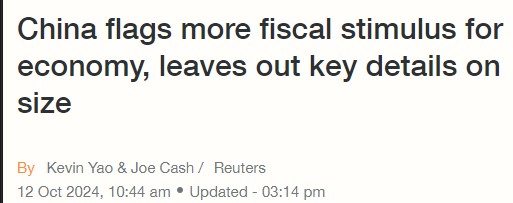
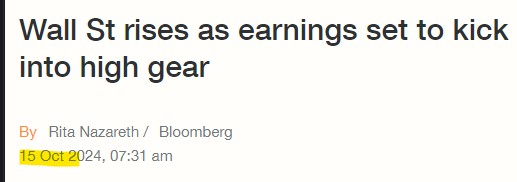
‘High stakes’ corporate earnings season, which kicks into high gear this month, is about to decide whether Wall Street’s good stories together with bullish investors could drive prices even higher amidst increasingly rich valuations in US market right now.
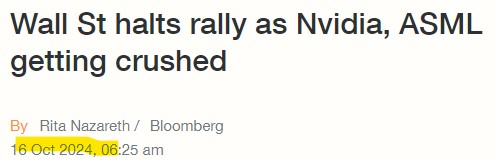
‘High stakes’ because one day you see this unfold
And then the next day, some new stories got thrown into the mix and this happens.
As autumn arrives and the leaves begin to turn, so too will the dials at central banks around the world.
Inflation is cooling off, the job market isn’t on fire, but it ain’t dead either, and the economy hasn’t fallen apart, but instead expected to ‘land softly’
US Fed, alongside its global peers like the ECB and Bank of England, are gearing up to slash rates in unison, like a well-oiled symphony orchestra.
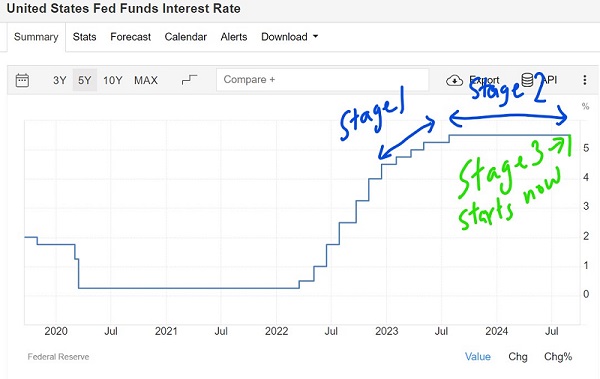
Stages of the Fed Pivot
After Jerome Powell’s Jackson Hole ‘sweet talk’ last month, the market’s got its bets placed on 3 cuts before year’s end.
And expect the ‘speed’ of interest rate will be like 0.25% every 3 months,
..nowhere as fast as interest rate hike in 2022 (0.75% every 3 months).
And that is the gist of it – anything higher than 0.25% rate cut per quarter can signal a perception that the economy is heading towards a recession/hard landing.
It’s like – you are referred to a neurologist due to a persistent migraine, but he said you need to be admitted to ICU immediately
Now you tell me whether you panic or not?
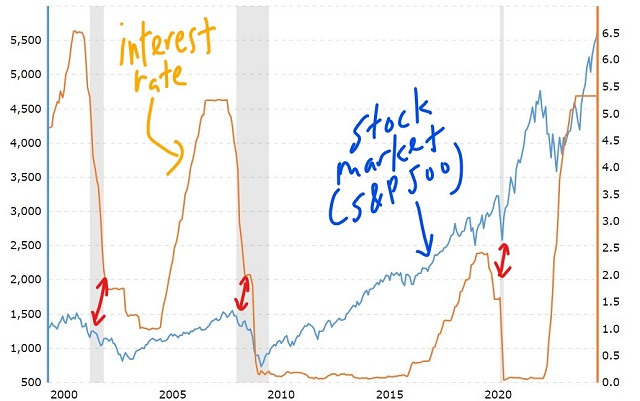
That’s the analogy all dual-mandate central banks want to avoid unless they really have no choice coz just look at what happened historically when there were fast & furious interest rate cuts…..
In other words, equities typically fare well on the back of falling interest rates, except when faced with recession.
You’ll learn a new term today – A Goldilocks scenario, which refers to:
An ideal economy scenario where it warm enough with steady economic growth to prevent a recession, but growth isn’t so hot as to push it into an inflationary status.
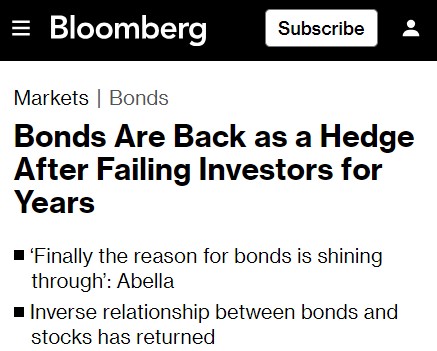
Although the above is somewhat beyond our control that, but we can have something to hedge against it 👇
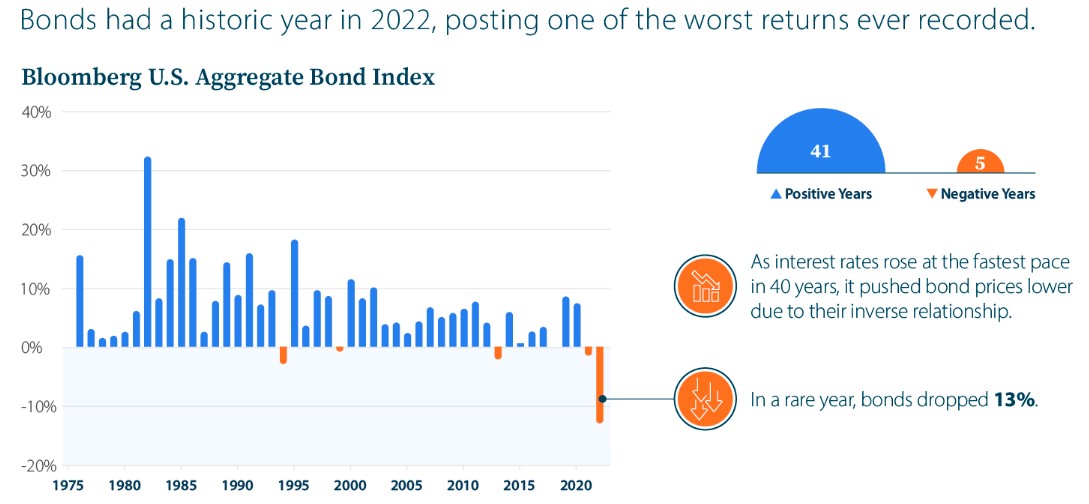
In fact, the more ambitious ones are loading up on bonds with the longest maturity, anticipating both capital gains & ‘locked in’ interests, at the same time minimizing reinvestment risks when interest rates decline from here.
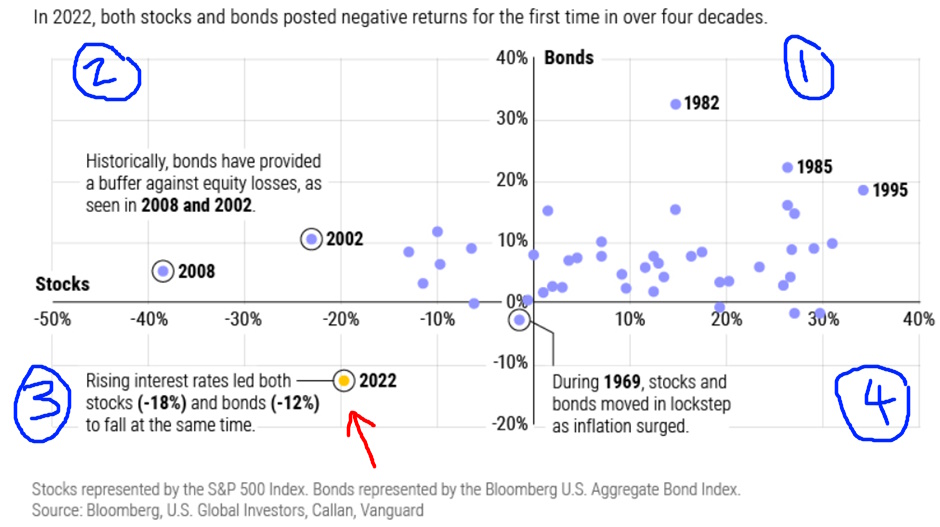
One lil’ caveat: Provided what happened in 2022 to bond markets does not repeat.
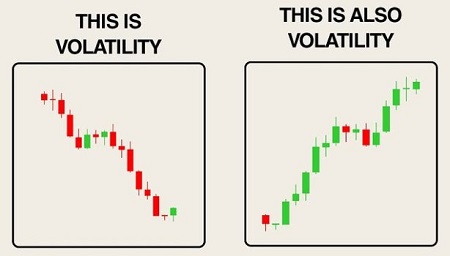
In summary, stay invested but exercise caution. And brace for volatility.
Higher than average market valuations means prices will be more vulnerable to bad news (twisted as it might be, sometimes bad news can be good news, and vice-versa)
Rgds
Lieu
p.s.
When people say ‘in a high-interest rate environment, you don’t take on debt (mortgages for individuals, issuing bonds for companies).
But a CFO of PLC said he doesn’t understand this logic coz if you can afford to pay high-interest rates, you should take on debt now because interest rates will NOT stay high forever.
When rates go down, you can even refinance – that’s more margin you can take.
What most people don’t realize is there are MORE risks in taking debts in a low-interest rate environment, coz when rates go up, you might encounter repayment problems.
On the corporate side, that is precisely why you see PLCs like MyEG & Yinson issued bonds this year, offering yields many times higher than their own stocks dividends