Author: LieuCF

  • Global REIT Investing: Bench marking the Best

    2 words of utmost importance here: Benchmark and ‘the Best’.

    Where to benchmark? Answer: US – the bellwether of global economy

    Who to benchmark? Answer: Warren Buffett & Berkshire Hathaway – legendary

    Follow the 3 lessons below in sequence to grasp the idea why REIT, as an asset class, is so powerful throughout multiple cycles of economic ups and downs

    Lesson 1: Even world’s best investor had deteriorating performance over time due to high ‘competition’ & information ‘liberalization’


    Lesson 2: The second best asset class to closely match the world’s best investor investment return for the past 20+ years

    Note: concepts covered in these lessons still apply, but refer to the updated tables below


    Lesson 3: To complete Lesson 2, we analyzed how had other asset classes performed in the same duration

    NOTE: Up-to-date data for the above is available when you schedule a 1on1 consultation call with me ~ I’ll show you everything up to most recent full financial year

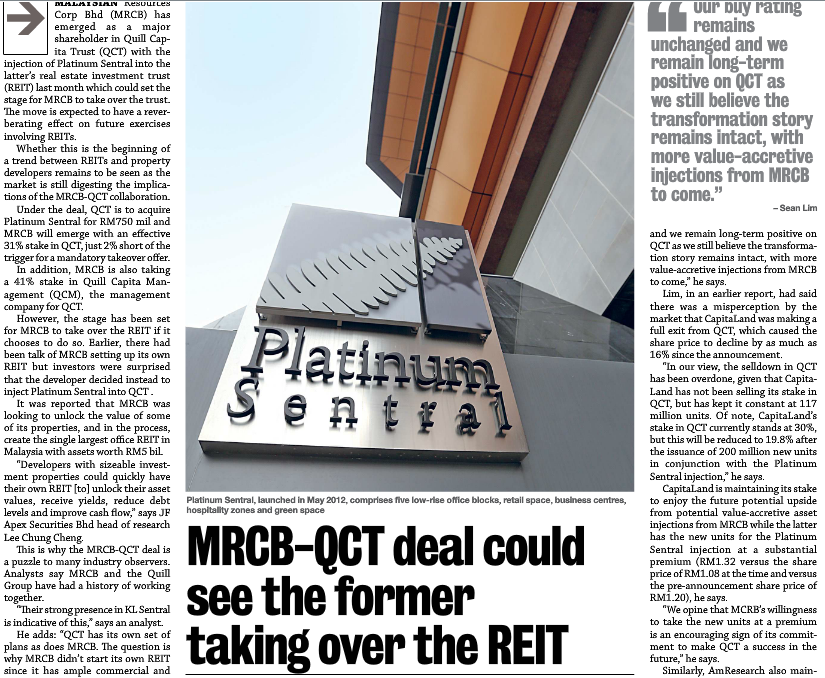
  • M REIT Sector Updates: MRCB-QCT REIT Merger [Subscription Level only]

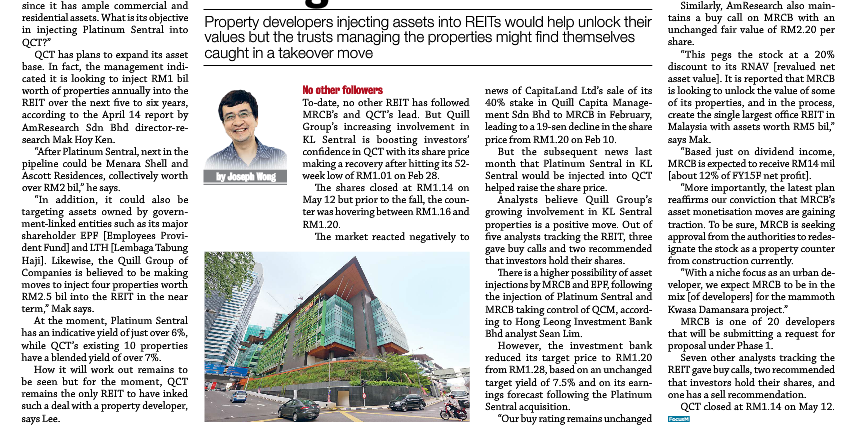
    Source: Focus Malaysia May 2014

    QCAP May14a


    Click to view Full Size High Resolution version of the article

    QCAP May14b

    Click to view Full Size High Resolution version of the article

  • M REIT Sector Updates Jan 2014 [Subscription Level only]


    New REIT?

    MFocus REITMethod Jan14

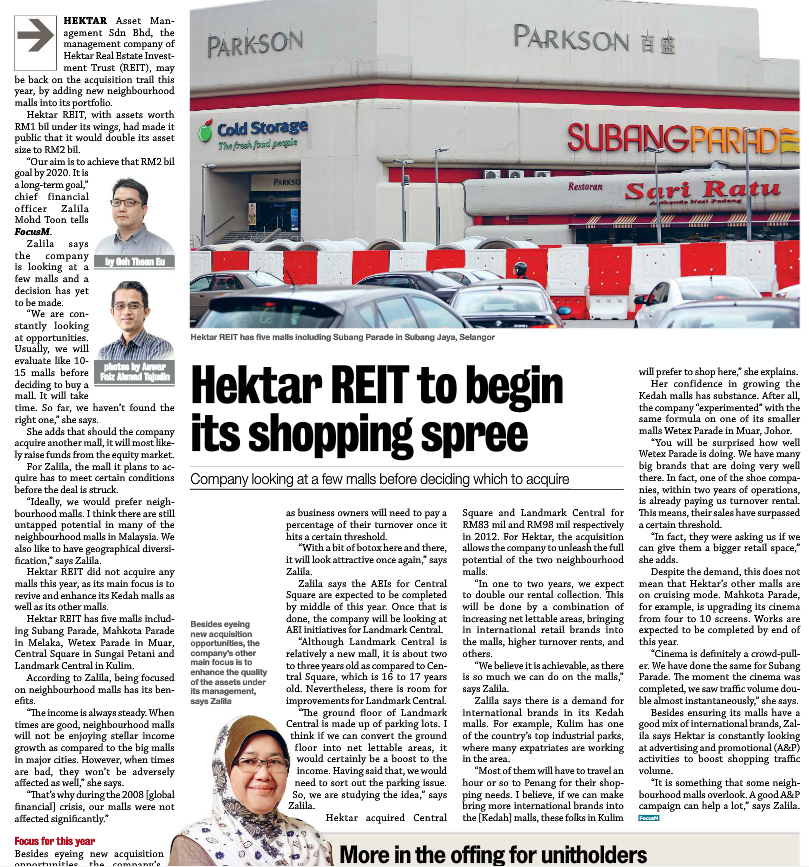
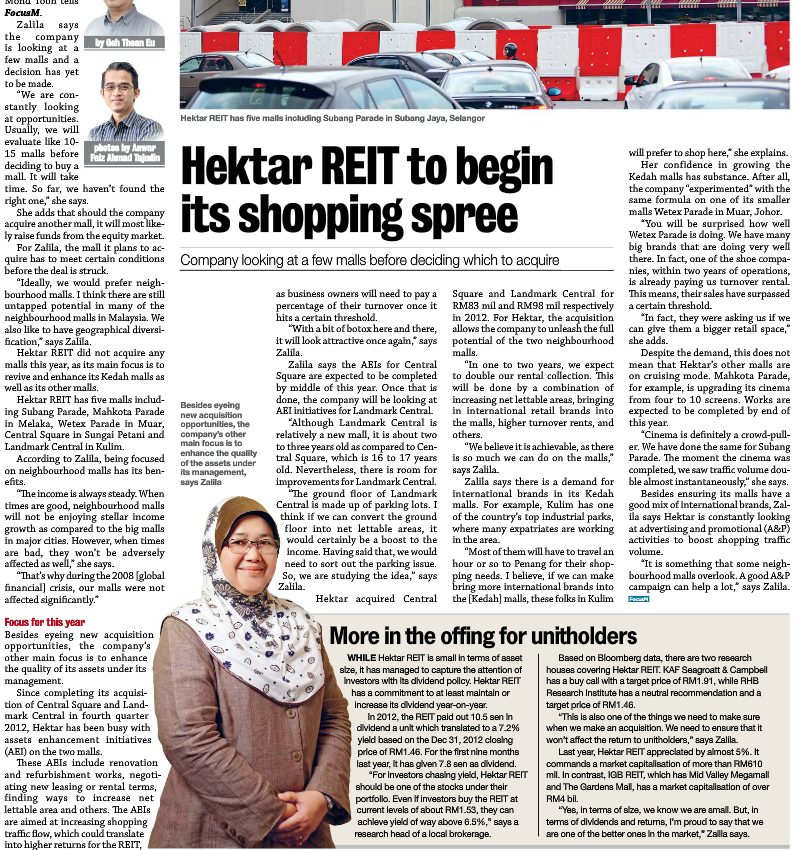
    Hektar REIT Prospect

    MFocus REITMethod Jan14a

    MFocus REITMethod Jan14b


  • M REIT Sector Updates Going into 2014 [Subscription Level only]

    Some said – REIT really cannot perform this year. Me? I wouldn’t put it as such, but rather it is indeed a “mild” year with not much executed deals. Good thing is, if we all have used the right method to enter, then we’ll still have a bird in hand – which is the guaranteed dividend distributions in the range of 5 to 6% , while sleeping. There is no deterioration in the fundamentals, except for some asset classes of property in REIT that is affected by the softening business outlook or due to factors beyond a REIT manager control (like MRT construction works affecting the revenue of CMMT’s Sungai Wang mall) 

    If an investor is lacking patience, then he/she shouldn’t invest in REIT all. REIT is like a good ol’ wine, the longer you hold the better. Of course, if substantial appreciation has taken place in your REIT portfolio, then you might consider of realizing the gain in anticipation of a drop for re-entering

    And they said, having knowledge is power. That’s why people got arrested for insider trading . However, for retail investors like the rest of us, it is good enough to have more information than the rest of the retail investors or institutional fund manager who has yet to take any position into this. With drop in many M-REIT prices(as of mid Dec 2013), take a look of the points below. Disclaimer – this is not an invitation to buy or sell. I am having long position in CMMT, Hektar, IGBREIT, PavREIT, Al-Aqar REIT, Starhill REIT, UOA REIT, Tower REIT, AmFirst and SunREIT.

    Real estate property over-valued or stocks over-valued?

    Everyone is entitled to its own opinion, yes? If you want to play property in 2014, then take note of this piece of news below, unless you are cash rich and can afford not to take any mortgage.  Furthermore there is rumour BLR is going to go up 0.25% in 2014. Source – Focus Malaysia Dec 2013
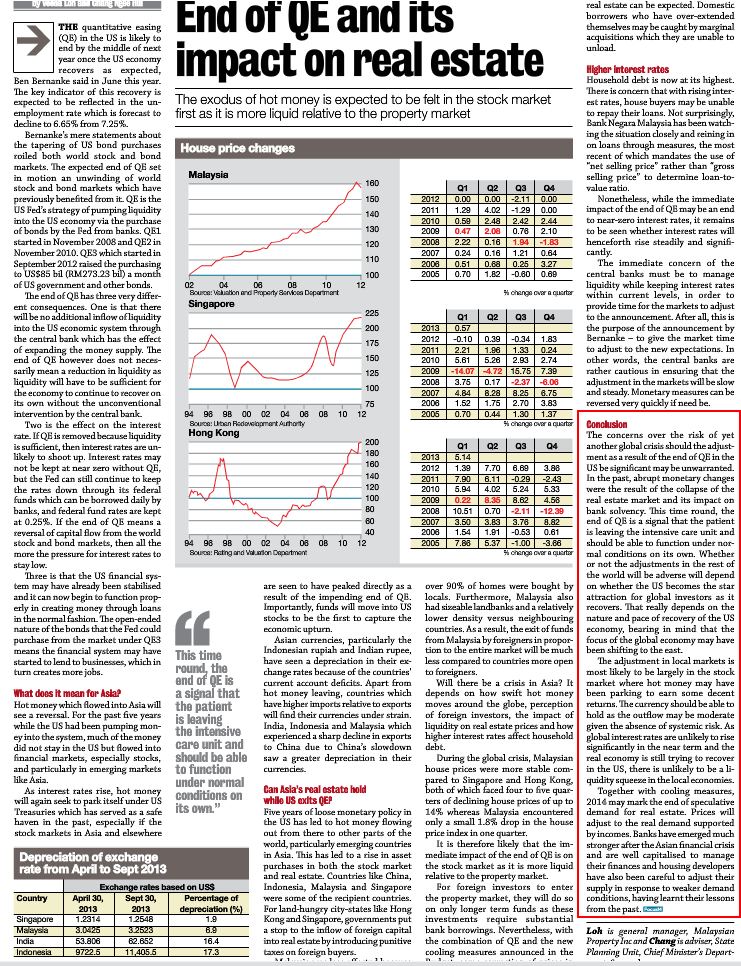
    QE real estate

    How Li Ka Shing is having a stake in AmFirst REIT

    Here’s the kicker – Li Ka Shing’s “dormant” interest in a M-REIT? The below is self explanatory, but nothing happens until the malls he owns gets injected into AmFirst. Source – Focus Malaysia Dec 2013
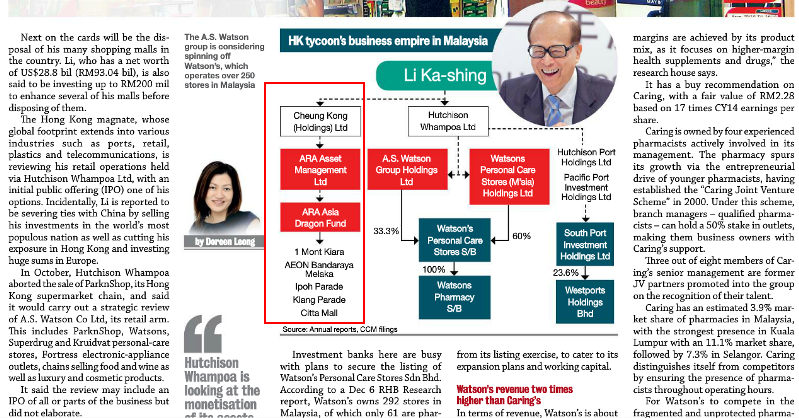
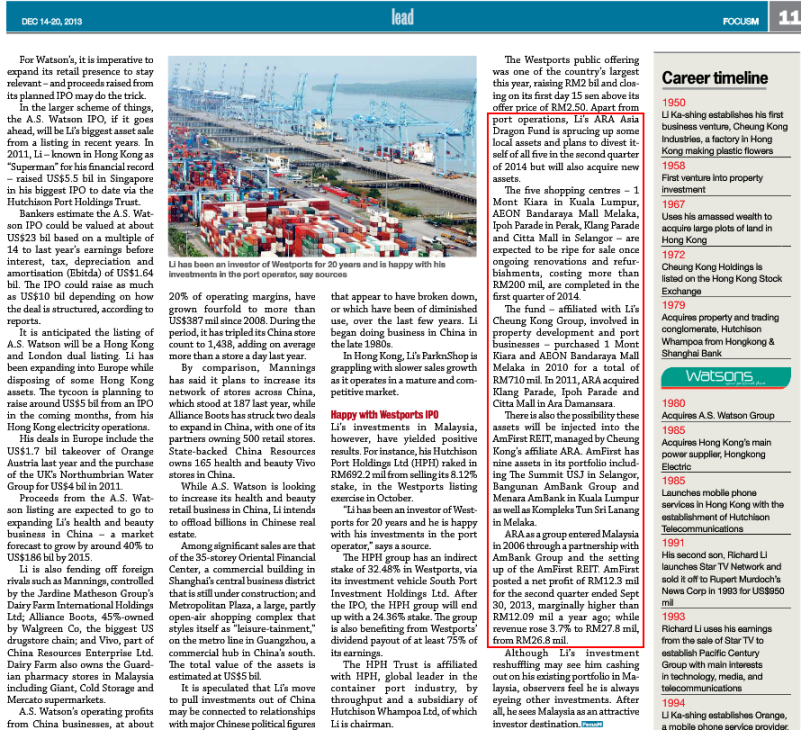
    li ka sing holdings


    li amfirst

     How DBKL Assessment Fee and Electricity Tariff Hike affects REIT

    A prudent REIT Manager will have clauses in their tenancy agreement to pass this extra costs to their tenants. We don’t know for sure for all REITs, but it should be. Even MRMA Chairman, Dato’ Stewart Labrooy said – “other REIT manager should have this clause in their tenancy agreement“. So I won’t worry this much in the long term. Worse case is, the drop in net profit is short term as when the tenancy agreement is renewed, surely such costs will be added in. If an investor is really worried, stay away from REITs with KL properties for now. 

    Another thing is, as long as the mall itself in prime area, there is no where for the tenants to run. “Sticky” tenants aye? Aspirational and fashion brands like Coach, would you expect them to do business in less prestigious area like some shoplots? No way!

    CLICK HERE to read more of the relevant news – which REIT has KL properties and how the quit rent/assessment is going to impact the net profit. Source: The Edge

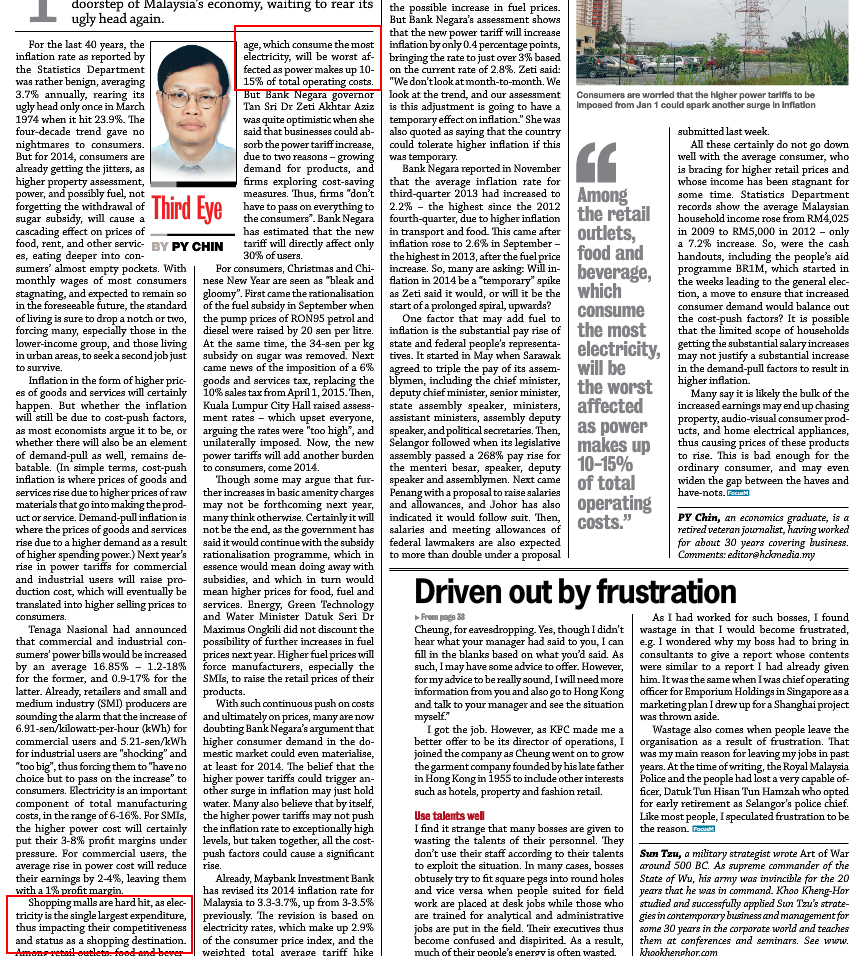
    The other thing is electricity. Expected 15% hike with retails REIT feeling the most heat.Source – Focus Malaysia Dec 2013
    reit hardest hit electricity

    Amanah Raya & Silver Bird – a revival?

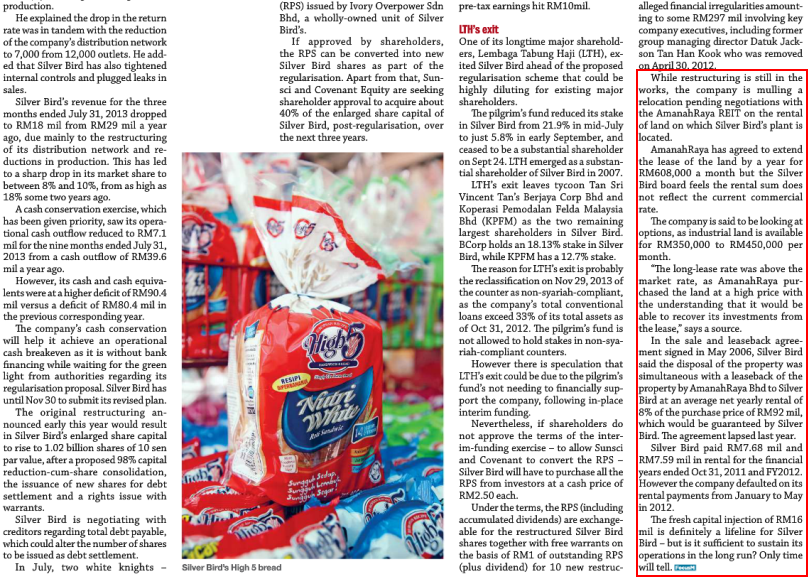
    NOT. Silver Bird is still shaky, hence it would directly impact Amanah Raya REIT as well. I think I am still going to stay away for now. Source: Focus Malaysia Nov 2013
     silverbird FM 2013

    Tropicana to be acquired by Tower REIT?

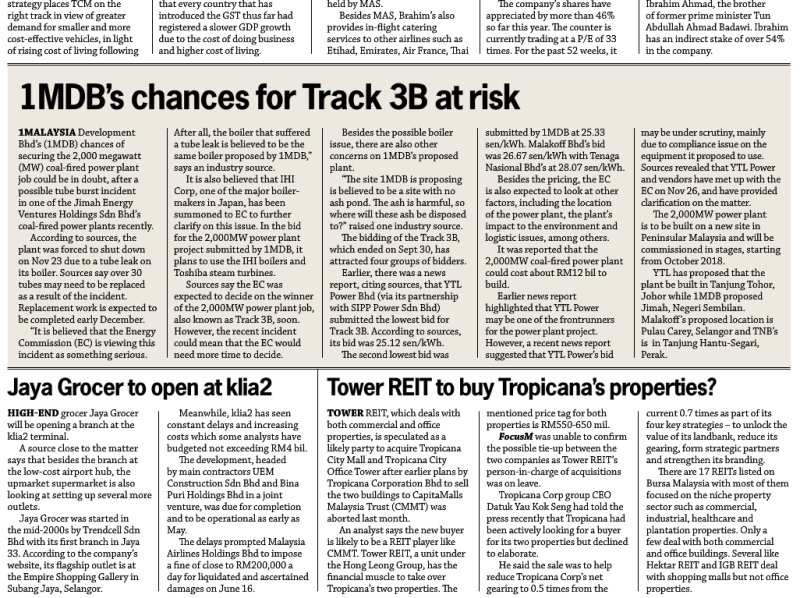
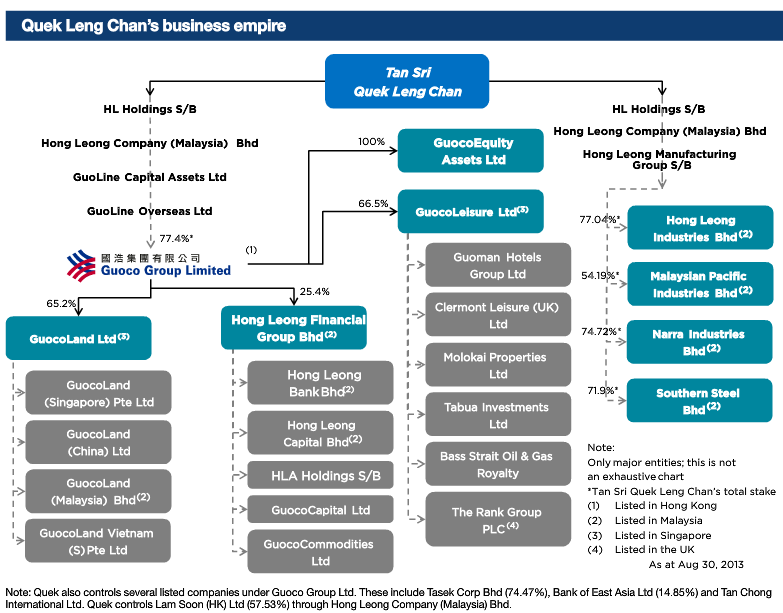
    This is yet to be seen. But it is possible, with Tan Sri Quek backing. Tower REIT 21+% stake is owned by GuocoLand Malaysia Bhd. Source – Focus Malaysia Nov 2013
    tower tropicana

    guoco tower reit

    Another property to be REIT-ed in 2014, I read, is Gurney Paragon Mall by Hunza Property.
  • M REIT Sector Updates July 2013 Webinar Replay [Subscription Level only]

    The content of this webinar:

    1. Why the selldown on M-REIT counters?

    2. The right questions we should be asking

    3. My positions in REIT at the time of this webinar

    4. Sector updates – REIT privatization and greenfield development

    5. Q & A session plus feedback from previous batch of members


    CLICK HERE for the HD version of the video

    The password to unlock the video is “webinarjul13”


  • AmFirst REIT Rights Issue Case Study in 2012

    I’ll share with the rest of the REIT Method community on how you can do the due diligence yourself, not only for this AmFirst REIT, but for other REIT rights issue as well.  Bear in mind that AmFIRST rights issue is the first for any M-REIT, so it is worth studying this although it is a bit outdated

    In case you are not aware,  AM Ara (property manager) has proposed renounceable rights issue of 3 new units for every 5 existing units held under an investor’s portfolio.

    In layman terms, for every 500 shares (5 lots) of AmFirst REIT you currently have, you are entitled to buy additional 300 (3 lots) shares, at a subscription price of RM 0.85/share in mid July.

    Is this a good thing? To answer this, lets take a look at 2 things below.

    The purpose of this rights issue

    The REIT manager stated that it wants to grow its portfolio by investing in more properties in high-growth areas such as Penang, Melaka and Johor. Apparently, they are now moving their focus from KL/Klang Valley to other places where asking prices and rental yields are more reasonable. Scope and size of the the properties is still under wraps, as they claimed they are still doing some “due dilligence” exercise.

    Read: AA – Asset Acquisition Effort, one of the criteria of active asset management we want to see in a REIT, as stated in Module 3.

    Its current Gearing Ratio

    To quote Transformers the movie, there is always more than meets the eyes.

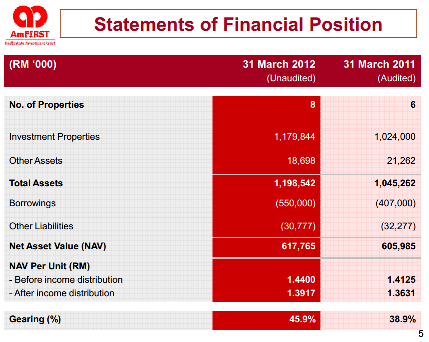
    Let’s do a quick check into its latest quarterly financial statements, and look at the gearing ratio.

    It is at 45.9 percent, up from 38.9% from the same quarter last year.

    Reason of the increase in gearing: New Property Acquisition of Prima 9 and Prima 10 at Cyberjaya, both are relatively new office buildings. It is normal to see gearing shoot up after acquiring new assets.

    Bonus point#1 to note: Both commercial office buildings are 100% tenanted as of the time of this writing.

    Bonus point#2 to note: One of the major tenants is Hewlett-Packard, a MNC (multinational company). Established MNC are normally quality tenants known for long lease.

    Even though the manager said the right issue is for asset growth, its equally, if not more, important aim is to pare down the gearing ratio to below 30 percent.

    Why is this so?

    There is no way AmFirst can acquire new properties this year with only less than 5 percent margin before hitting the 50% gearing ratio upper limit. Besides that, reducing the gearing will indirectly result in interest (over its borrowings) savings as well.

    This is prudent capital management in strengthening the REIT’s balance sheet via capital raising. The property manager is doing the right thing.

    Conclusion: With all the info we know so far, subscribing to this rights issue is recommended.

    This article does NOT form part of the contract in whatsoever way if any. We are solely sharing our own personal opinions on this particular investment opportunity base on our best knowledge on this matter which may be limited in certain aspects that we are not aware of at the time of this article was posted.
    We make no warranty or representation about the content of on this tutorial although we try to provide the most accurate info available to us. It is your responsibility to independently confirm its accuracy & completeness. Any projections, opinions, assumptions or estimates used are for example only & do not represent the current or future performance of the REIT. If you have questions or concerns regarding this issue conduct further inspections by a qualified professional.
    The information provided on or within this website or in documents available herein is for assistance only and is not intended to be and must not be taken alone as the basis for an investment decision. Each recipient of this information should make such investigations as it deems necessary to arrive at an independent evaluation of an investment in the securities offered hereby, and should consult its own legal counsel and financial, accounting, regulatory and tax advisors to determine the consequences of such an investment.
    In short, we shouldn’t be blamed for any of your investment loss.


  • To subscribe or not to subscribe, that is the question

    A member,Tze Lin, asked the following question, in response to AmFirst REIT Rights Issue 2012

    Is there any impact to an existing Amfist investor(unit holder) if he/ she decides not to subscribe to the right issues. Impact in the sense of dilution of shareholding, or diminution in share value?

    Here is an insightfully simplified way to look at Rights Issue.

    Assume LCF Corporation has 1000 shares outstanding with an asset base of $1000. NAV/share = $1. For simplicity sake, assume its current stock price is also trading at its $1.

    Unit holder Tze Lin owns 200 shares in LCF Corporation.  Therefore, her asset value is $200 and she has 20% stake in LCF Corporation.

    LCF Corporation then announces a 1 for 1 rights issue with a subscription price of $0.50 each.

    Layman terms: Unit holder is eligible to purchase 1 additional shares at the price of  $ 0.50, for every share currently held under her portfolio.

    The rights issue is a discount to the current market rate because its rights price is lower than its NAV/unit.

    After the rights issue (assuming rights issue is fully subscribed), LCF Corporation would have 2000 total shares outstanding with an total asset value of $1500. NAV/share is now at $0.75.

    If Tze Lin subscribes fully to her entitlement, Tze Lin will need to invest an additional $100 lump sum ($0.50 x 200 entitled rights). Tze Lin will now own 400 shares in LCF Corporation. Her ownership remains at 20% of the total corporation while her asset value is at $300.

    However, if Tze Lin chooses to forfeit her rights, now she will only have 13.33% stake ($(200/1500), reduction from 20%) while her asset value still stands at $200 (13.33% x $1500, no change).

    So we can see that in this scenario, Tze Lin does not really suffer any loss in absolute monetary terms.

    In other words, there is NO dilution in share value.

    However, there is indeed a dilution in Tze Lin shareholding in LCF Corporation.

    Does the reduction in a company stake matter to you?

    Yes if you sitting in the Board of Director who need to hold the power in decision making.

    Minority shareholder aka man in the street like you and me?

    I don’t think so 🙂

  • Wise Things to Do with Rights Issue

    In response to lesson – To subscribe or not to subscribe, that is the question, REITMethod member, CK Lau, has this to say:


    But the “Mr. Market” will cost in the reduce NAV/share which is now 0.75 into their buying price and the trading share price will “slowly” adjusted to 0.75 instead of 1.00… then Tze lin would have suffer a paper lost 25%….


    Unfortunately, for Tze Lin, that is likely to happen in the short term if she allows her rights entitlement to expire.

    In fact, there is this LIMITED TIME FRAME before your rights issue option-to-subscribe period expire.

    If you DO NOT act wisely within that stipulated time, you will SUFFER PAPER LOSS in your invested stocks after Rights Issue, should you need to liquidate your positions.

    Even if you decide NOT to do anything, you might be Caught Off Guard by the drop in your invested stock price even the Market is Up and the fundamentals are intact.


    After the rights issue, the theoretical stock price will drop to $ 0.75. However, nobody knows this for sure actually, and even if it drops, it might rise again in the future to a level where Tze Lin no longer suffers any paper loss.

    Another thing is…

    Although the stock price is not likely to change immediately following the new rights issue, it will change as the rights expiration date approaches.

    Anyway.

    You can BUY or SELL the rights shares

    Here I explain more in detail using a video, especially the BUY part, which is more complex.


    Updated: Sept 2019 – How to Subscribe to Rights Issues fully online


    Downloads

      [op_file_download_item title=”How%20to%20Handle%20Rights%20Issue%20Shares” icon=”style1-Pdf-64×64.png” file=”https://s3-ap-southeast-1.amazonaws.com/reitmethodmys/Rights+Issue+in+Stocks.pdf” package=”” level=”” new_window=”Y”]Download%20the%20presentation%20slides%20for%20the%20video%20above[/op_file_download_item]


    Sell all the rights shares

    Tze Lin can sell his 200 entitlement shares at the price of, say,  $ 0.25/unit. She will gain $ 50.

    After the ex-date when the share price does fall to $ 0.75,  her existing 200 shares will be valued at  $ 150, which is lower than her initial investment capital of $ 200.

    However, since she already gains $ 50 from the sale of rights, in the end she does not gain or lose money from the rights issue ($ 150 + $ 50 = $ 200).


    Sell partially the rights shares

    This is to cover for the subscription of the other part of the rights.

    Say, if the entitlement shares are sell-able at $ 0.25/unit, Tze Lin can sell 140 out of the 200 entitlement shares, which will net her $ 35.

    Then, she could use the capital raised ($ 35) to purchase the remainder 60 entitlement shares, for a total cost of $ 30 ($ 0.50 x 60), with $ 5 extra to cover for the transaction fees.

  • Module 3C: How to Know a REIT is Undervalued?

    Value investing is all about buying undervalued stocks.

    You forego consumption and put away a lump sum now in expectation of more future cash flows.

    For REIT stocks, it is no different.

    The metric to look for is NAV per share (NAVPS) or NAV per unit.

    If the current stock price is less than its NAVPS, then it is considered undervalued, and vice-versa.

    This is just one of the many criterion to look for in value investing. There is, however, no guarantee that buying undervalued REIT stocks will net your high returns in short term.

    Likewise, it does not mean overvalued REIT stock should be shunned at altogether.

    But in long term, there is better chances of getting higher return if you buy in a stock when it is undervalued.

    Learn how to find this NAVPS figure in annual report.

  • Module 3D: The Valuation aka Earnings Power of REIT

    Looking at the NAV versus price is the way to see if the REIT is undervalued.

    But there is more than one way to value REIT, and if the criterion are met for most of them, this would be Buffett’s way of REIT investing.

    It’s not rocket science, I’ll show you how.

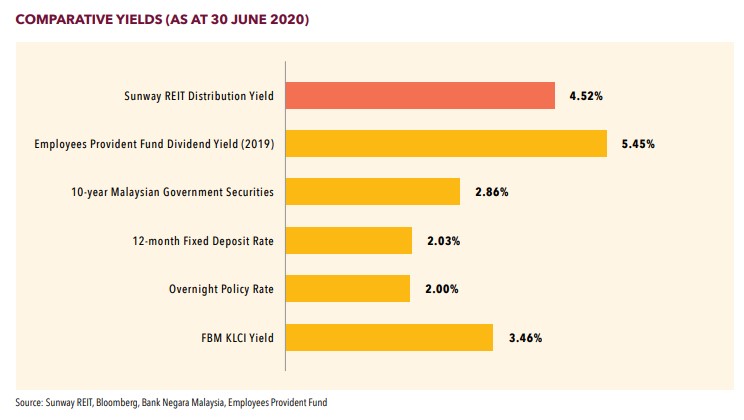
    Always compare REIT dividend yield with FD & MGS
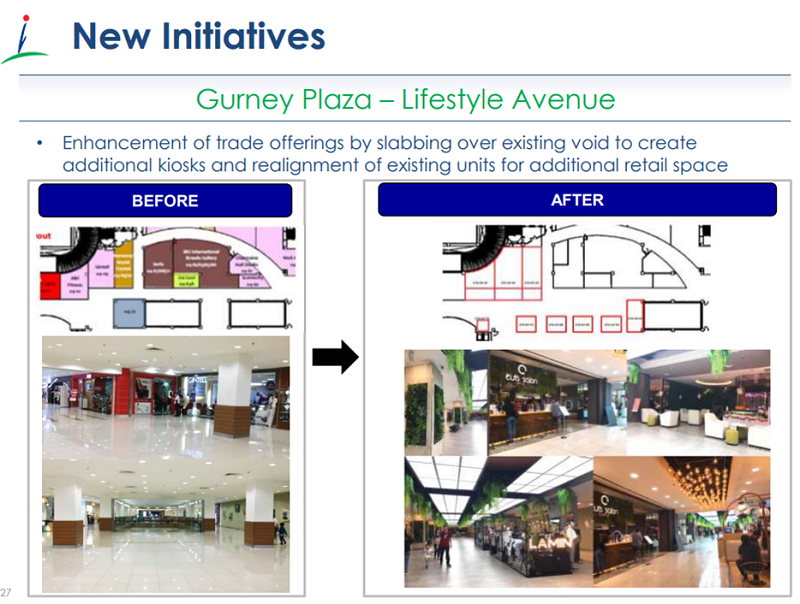
    Example of creating more space (NLA, Net Lettable Area) to generate More Rental Income
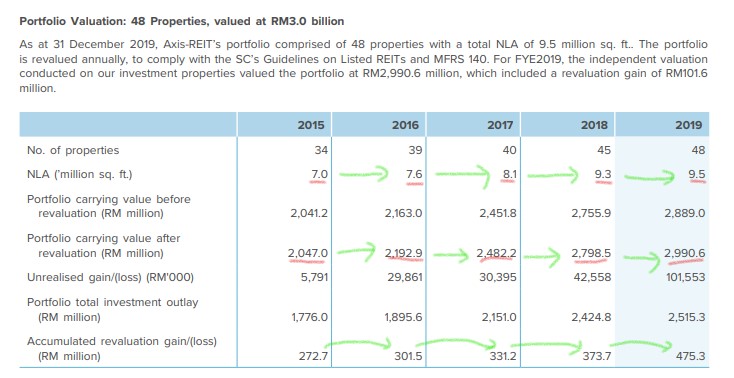
    Good Example of Increase Property Valuation by Active Acquisition
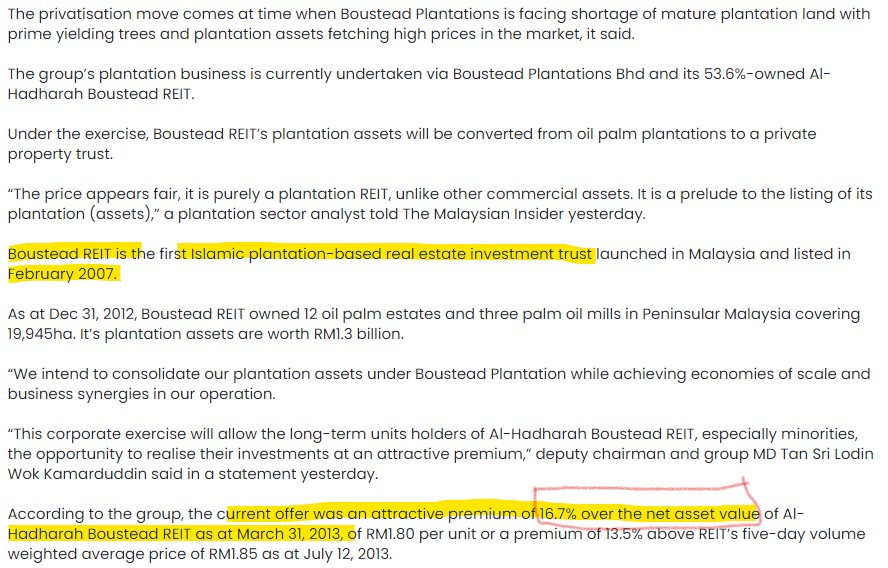
    Example of MREIT delisting – best if your average purchase price per share stays below or around the NAV/unit of the REIT
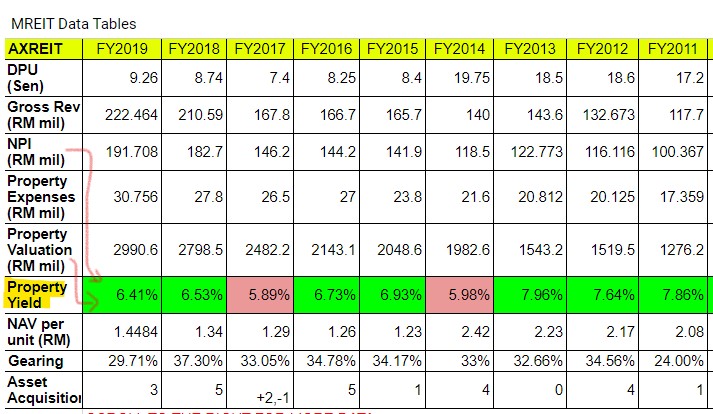
    Calculating Property Yield (not shown directly in REIT annual report)
  • Reading REIT Annual Report #1

    Case Study: Hektar REIT

    Finally, we’ve come to the part where we applied what we have learnt in all previous modules.

    All lessons in this section will show you, interactively, how to read REIT annual report before you invest. And if you are already invested, how do know if the REIT investment in your portfolio is still a good investment to hold on?


  • Reading REIT Annual Report #2

    Case Study: Axis REIT

    Finally, we’ve come to the part where we applied what we have learnt in all previous modules.

    All lessons in this section will show you, interactively, how to read REIT annual report before you invest. And if you are already invested, how do know if the REIT investment in your portfolio is still a good investment to hold on?


  • Reading REIT Annual Report #3

    Case Study: IGB REIT

    Finally, we’ve come to the part where we applied what we have learnt in all previous modules.

    All lessons in this section will show you, interactively, how to read REIT annual report before you invest. And if you are already invested, how do know if the REIT investment in your portfolio is still a good investment to hold on?


  • Module 4 REIT Class – Retail

    The defensiveness of retail REIT is legendary. Here, we will examine why.

    However, going forward, with the emergence of e-commerce, things might not look so rosy anymore.

    That being said, online shopping will NOT kill malls.

    Better malls will make lesser malls close shop, fast.

    A similar analogy is the share market itself.

    There may be 200 listed companies and and over 100k Buy/Sell transactions everyday; however, that does not mean every counter will has equal number of transactions.

    Probably 80% of the transaction volume are concentrated on 20% of all the counters in the market. The rest of of counters may not see any buyers or sellers at all in a day, and hence their prices will be going nowhere, and soon, be forgotten.


    Being a tenant in a retail mall, especially the ones managed by a REIT manager, is serious business.

    Rental rates are normally calculated based on monthly turnover rates (profits made). The rates are either calculated based on the percentage of the tenant’s gross turnover or this formula below:

    Base rent + Service charges + Promotion charges + % (e.g. 1%) of gross sales


    In non-financial terms, the monthly rental rate for mall spaces will depend on the monthly profits made (sales), any promotions carried out, the services offered and the minimum rent agreed by both parties. The mall management can also have access to the financial records of the tenants (ie: the receipts, invoices and audit reports).

  • Module 4 REIT Class – Healthcare

    If you thought retail REIT is defensive, wait until you examine the characteristic of healthcare REIT.

    These REITs are far and between, for reasons as shown in this module, below.

  • Module 4 REIT Class – Office

    Office REIT generally is one of the least defensive due to oversupply, but for well established office REITs, this would be of little effect when the REIT manager is competent in managing their office assets.

    Here’s what you should know about office REIT.

  • Module 4 REIT Class – Industrial

    There’s a lot of room for growth for industrial REIT in Malaysia, but there’s also risk associated with industrial properties as well.

    But this can be mitigated by a competent manager.

    Here’re the things investor should know about the characteristics of industrial REIT.

  • Module 4 REIT Class – Hospitality

    It takes skill and foresight to manage a hospitality REIT.

    It has more intrinsic uncertainty compared to other class of REITs, but then again this depends on how the manager manages it.